School Water Tank Cleaning Bangalore
School Water Tank Cleaning Bangalore: Professional Water Tank Cleaning Services for Schools
Clean water is essential for every school. Students, teachers, administrative staff and support teams depend on a reliable water supply throughout the school day. Water is used for drinking, handwashing, toilets, food preparation, cleaning classrooms and maintaining general hygiene. While schools often focus on the quality of their incoming water supply, the condition of the storage tanks is equally important.
Over time, school water tanks and underground sumps can collect mud, sand, dust, sludge, algae and other unwanted deposits. These materials may enter through the water supply, damaged tank covers, open access points or surrounding environmental conditions. If tanks are not inspected and cleaned regularly, accumulated deposits can affect the appearance, smell and overall hygiene of stored water.
This makes school water tank cleaning in Bangalore an important part of planned school facility maintenance. Educational institutions need a cleaning arrangement that considers tank capacity, daily water consumption, student safety, hygiene requirements and the school timetable.
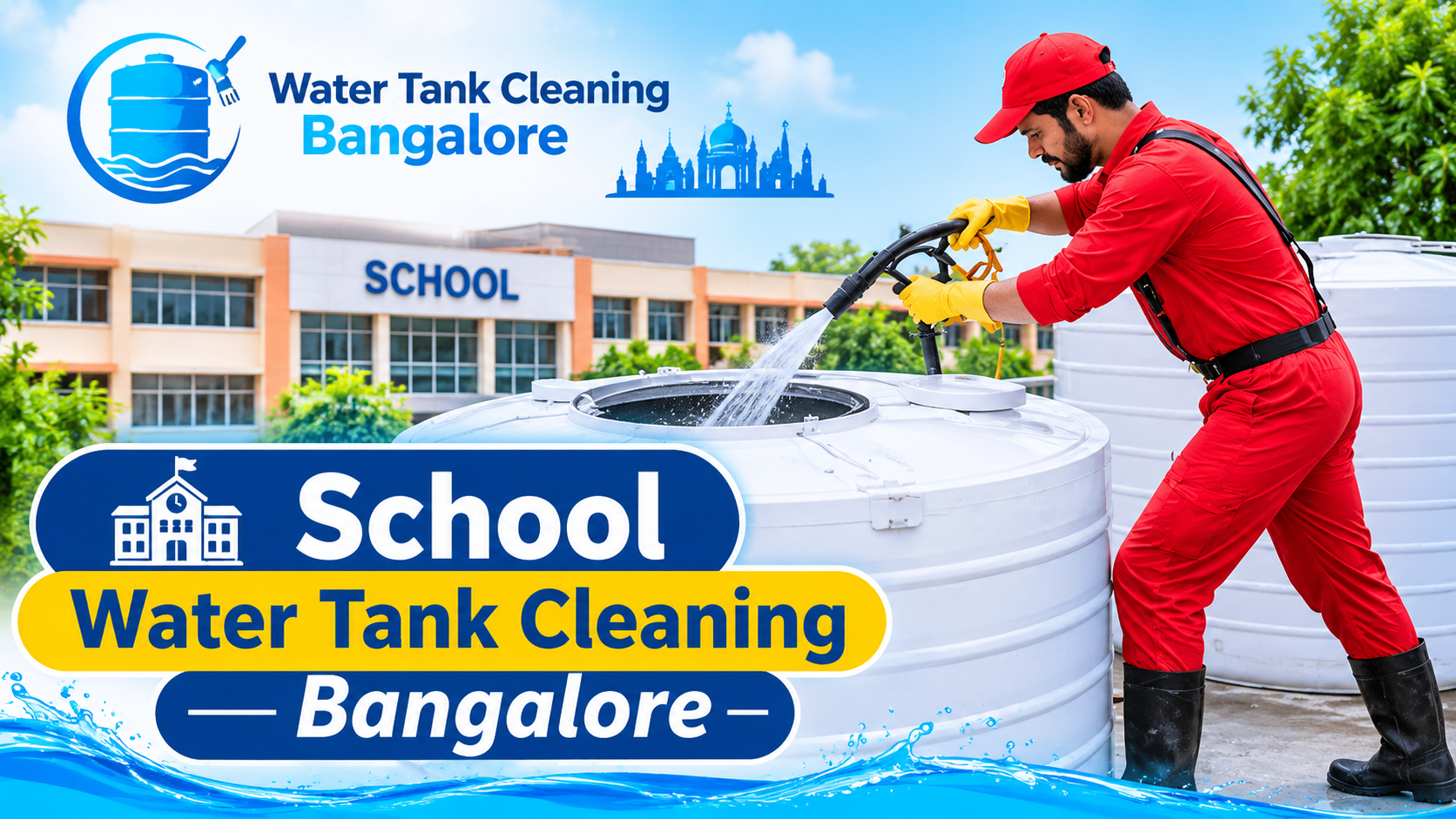
Water Tank Cleaning Bangalore provides professional water tank and sump cleaning services for commercial and institutional properties, including schools. The cleaning process can include draining stored water, removing accumulated sludge, scrubbing internal surfaces, pressure washing where appropriate, rinsing, suitable disinfection and a final inspection.
Whether your institution operates a small primary school, a large campus, a residential school or a college, regular tank maintenance can help maintain a cleaner water storage environment.
Why Is School Water Tank Cleaning Important?
Schools serve many people every day, and their water storage systems may support several buildings, classrooms, laboratories, kitchens, washrooms and other facilities. A single underground sump or overhead tank may supply water to multiple areas of the campus.
Without proper maintenance, sediment and dirt can gradually accumulate inside these storage systems. Regular cleaning helps address this issue and supports the school's wider water hygiene programme.
1. Removes Accumulated Sludge and Sediment
Water supplied to a school may contain small quantities of suspended particles. Over time, sand, mud, silt and other deposits can settle at the bottom of a tank.
As the deposits accumulate, they may become difficult to remove through ordinary draining. Professional cleaning helps remove these materials from the tank floor and other accessible internal surfaces.
Removing sediment is particularly important for large underground sumps that store water for several buildings.
2. Helps Maintain Water Storage Hygiene
The internal condition of a water tank can influence the hygiene of stored water. Dirt, organic matter and other deposits may create an undesirable storage environment.
Cleaning the tank helps remove visible deposits and allows the internal surfaces to be inspected. Appropriate disinfection can be carried out as a separate part of the process, using a suitable product and controlled procedure.
However, cleaning alone cannot guarantee that stored water is suitable for drinking. Water quality also depends on its source, treatment and distribution system.
3. Supports Student and Staff Hygiene
Students and staff use school water for many daily activities, including washing their hands, cleaning utensils and using washroom facilities.
Maintaining clean storage tanks is one part of managing the overall water supply system. It should be supported by clean taps, maintained pipelines, properly covered tanks and suitable water quality checks.
4. Helps Identify Tank Maintenance Problems
A cleaning visit also creates an opportunity to inspect accessible parts of the storage system.
Technicians may identify visible issues such as:
-
Cracks or damage to accessible tank surfaces.
-
Loose or damaged covers.
-
Visible corrosion in metal components.
-
Sediment around outlets.
-
Signs of leakage.
-
Damaged or poorly fitted access points.
-
Dirt entering through openings.
Structural defects and plumbing problems may require a separate repair service. Identifying them early helps school management plan the necessary maintenance.
5. Supports Planned Campus Maintenance
A school generally operates on a fixed timetable. Unexpected water interruptions can affect classes, washrooms, cleaning activities and food preparation.
Scheduling tank cleaning during holidays, weekends or suitable non-teaching hours can make the work easier to manage.
A planned cleaning programme also helps the administration maintain records and avoid leaving tanks unattended for long periods.
Common Types of Water Tanks in Schools
Different educational institutions have different water storage arrangements. A school may have one large underground sump, several overhead tanks or a combination of storage systems.
The cleaning procedure should be selected according to the tank's construction, capacity, accessibility and condition.
1. Underground Water Sumps
Underground sumps are commonly used to store water received from municipal connections, borewells or other approved sources.
These tanks may supply water to overhead tanks through pumping systems. Because they can store large volumes of water, sediment may gradually collect at the bottom.
School sump cleaning generally involves:
-
Inspecting the sump and its access arrangements.
-
Removing stored water using suitable equipment.
-
Extracting accumulated sludge and sediment.
-
Cleaning accessible walls and floor surfaces.
-
Rinsing away loosened deposits.
-
Carrying out suitable disinfection where required.
-
Inspecting the sump before refilling.
Underground tanks require particular attention to worker safety. They may qualify as confined spaces, so entry must only take place under an appropriate confined-space safety programme.
2. Overhead Water Tanks
Overhead tanks distribute water to different parts of the school building. They may be installed on rooftops, terraces or elevated service structures.
Dust, insects, leaves and other contaminants may enter if the tank cover is damaged or the access opening is not properly secured.
Overhead tank cleaning may include:
-
Inspecting the tank cover and access opening.
-
Draining the stored water.
-
Removing sediment and loose deposits.
-
Scrubbing the internal walls and floor.
-
Rinsing the tank thoroughly.
-
Applying suitable disinfection where required.
-
Checking the cover and accessible fittings.
Rooftop access and work at height must be managed using appropriate safety arrangements.
3. Plastic Water Storage Tanks
Some schools use plastic tanks for overhead or intermediate storage.
These tanks require cleaning methods suitable for their material. Excessive pressure, abrasive tools or unsuitable chemicals may damage the tank surface.
The cleaning team should select equipment and cleaning products according to the tank manufacturer's recommendations and the condition of the storage system.
4. Concrete Water Tanks
Large schools and educational campuses may have concrete underground or elevated tanks.
Concrete tanks can develop surface deposits, sediment accumulation and visible deterioration over time. Cleaning should be performed carefully to avoid damaging the tank surface.
Any cracks, seepage or structural defects should be assessed by an appropriately qualified professional.
5. Large Institutional Storage Tanks
Universities, residential schools and large educational campuses may operate high-capacity water storage systems.
These facilities may require multiple cleaning teams, specialised equipment, staged cleaning and coordination with the maintenance department.
The work plan should be based on the number of tanks, their capacity, water demand and the availability of alternative storage.
School Water Tank Cleaning Services in Bangalore
Educational institutions have different requirements from individual homes. A school may need cleaning for multiple tanks, large underground sumps, overhead storage systems and interconnected water distribution arrangements.
Water Tank Cleaning Bangalore provides sump and commercial tank cleaning services for institutional properties, including schools. The cleaning requirements can be assessed according to the type and condition of the storage system.
Primary and Secondary Schools
Primary and secondary schools need a dependable water supply for students, teachers and support staff.
The maintenance plan should consider classroom occupancy, washroom requirements, kitchen use and daily cleaning activities.
Cleaning can be scheduled during school holidays or other suitable periods to reduce disruption.
Preschools and Nursery Schools
Preschools and nursery schools require particular attention to their daily hygiene arrangements because young children use the school's water facilities throughout the day.
The water storage system should be inspected regularly, with suitable cleaning and maintenance arranged according to its condition and usage.
Residential Schools and Hostels
Residential schools and hostels may consume water throughout the day and night.
Their water storage systems may serve:
-
Student accommodation.
-
Dining halls.
-
Kitchens.
-
Bathrooms and washrooms.
-
Laundry facilities.
-
Common areas.
-
Staff accommodation.
Cleaning schedules should account for continuous water consumption and the availability of backup storage.
Colleges and Universities
Colleges and universities may operate several buildings across a large campus.
Their water storage infrastructure may include multiple sumps, overhead tanks and separate storage arrangements for hostels, laboratories, administrative blocks and dining facilities.
A coordinated maintenance plan can help the facility team schedule cleaning without unnecessarily interrupting campus activities.
Coaching Centres and Educational Training Institutes
Training institutes and coaching centres also depend on stored water for washrooms, cleaning and other daily requirements.
Even smaller institutions should include water storage inspection and cleaning in their regular facility maintenance activities.
Our Professional School Water Tank Cleaning Process
A systematic cleaning procedure helps remove accumulated deposits while allowing the tank to be inspected before it returns to service.
The exact process depends on the tank type, construction, capacity, accessibility and contamination level.
Step 1: Initial Tank Inspection
The first step is to understand the school's water storage arrangements.
The cleaning team should assess:
-
Number of underground and overhead tanks.
-
Approximate capacity of each tank.
-
Tank construction and condition.
-
Access openings and accessibility.
-
Visible sludge or sediment.
-
Water condition and reported concerns.
-
Available backup water storage.
-
Preferred cleaning schedule.
This assessment helps determine the equipment, manpower and time required.
Step 2: Planning the Water Supply Interruption
Before draining a tank, school management should be informed about the work schedule.
The facility team should identify the areas supplied by the tank and determine whether alternative water storage is available.
For larger campuses, cleaning can be organised in stages so that every storage tank is not taken out of service simultaneously.
Step 3: Draining the Stored Water
The stored water is removed using a suitable drainage or pumping method.
The team should take care that discharged water does not create flooding, slippery walkways or other problems around the school premises.
Drainage arrangements should also prevent wastewater from entering nearby clean water storage areas.
Step 4: Sludge and Sediment Removal
After draining, accumulated mud, sand, silt and sludge are removed from the tank floor.
Suitable equipment may include sludge extraction systems, pumps, vacuum equipment and manual cleaning tools.
The method depends on the tank design and the amount of accumulated material.
Step 5: Scrubbing and Pressure Washing
The internal surfaces are cleaned to remove remaining dirt and deposits.
Scrubbing tools and pressure washing equipment should be selected according to the material and condition of the tank.
The objective is to clean accessible internal surfaces without causing unnecessary damage.
Step 6: Rinsing the Tank
After scrubbing, the tank is rinsed to remove loosened deposits and cleaning residues.
The rinsing process should be thorough, particularly where the tank is used for storing water intended for drinking or food preparation.
Step 7: Suitable Disinfection
Cleaning and disinfection are related but separate activities.
Cleaning removes physical dirt and deposits. Disinfection uses an appropriate method to reduce microorganisms on surfaces.
The disinfectant, concentration, contact time and rinsing requirements must be suitable for the intended water storage application and must follow product instructions and relevant guidance.
Chemical products should never be mixed without explicit instructions permitting it.
Step 8: Final Inspection
Before the tank is returned to service, the team should check the accessible internal surfaces and confirm that visible cleaning residues have been removed.
The access cover, inlet, outlet and other accessible fittings should also be checked.
If structural damage or plumbing concerns are identified, the school should arrange the necessary repair work.
Step 9: Refilling and Handover
Once the tank is ready, it can be refilled according to the school's water supply arrangements.
The facility team should confirm that the tank cover is properly secured and the water distribution system is operating as expected.
Where water quality is uncertain, appropriate laboratory testing should be arranged before the water is relied upon for drinking.
How Often Should Schools Clean Water Tanks in Bangalore?
There is no single cleaning interval that is appropriate for every school. The frequency depends on several factors, including incoming water quality, tank condition, sediment accumulation, storage capacity and daily consumption.
Schools should establish an inspection and cleaning schedule based on a site assessment and applicable public health guidance.
A practical starting point is to inspect storage tanks regularly and plan cleaning approximately every three to six months where conditions justify it. Tanks with frequent sediment accumulation or suspected contamination may need earlier attention.
Factors That Influence Cleaning Frequency
1. Source of Water
The incoming water source can influence the amount of sediment entering the storage system.
Schools using different sources should monitor water quality and inspect tanks according to their individual conditions.
2. Tank Capacity
Large storage tanks may serve a substantial portion of the campus. Their cleaning requirements depend on the quantity of water stored and the amount of sediment entering the system.
3. Daily Water Consumption
Schools with hostels, dining halls and large student populations may use considerably more water than smaller day schools.
Higher consumption does not automatically mean more dirt, but it makes regular inspection and reliable maintenance planning especially important.
4. Condition of Tank Covers
Damaged or poorly fitted covers may allow dust, insects, leaves and other unwanted materials to enter.
A secure cover is an important part of preventing contamination between cleaning visits.
5. Previous Cleaning History
A tank that has not been cleaned for a long period may contain heavier deposits than one maintained regularly.
The first cleaning may therefore require more time and equipment.
6. Unusual Water Conditions
Cleaning and inspection should be arranged sooner if school staff notice:
-
Unusual smell.
-
Visible particles in stored water.
-
Discolouration.
-
Floating debris.
-
Visible algae.
-
Unexpected sediment at taps.
-
Signs of contamination around the tank.
If unusual water conditions continue after cleaning, the incoming supply and distribution system should also be investigated.
Best Time to Schedule School Water Tank Cleaning
Timing is particularly important when cleaning tanks in educational institutions.
A school needs to maintain water availability while avoiding unnecessary disruption to classes and campus activities.
During School Holidays
School holidays can be suitable for major cleaning work because student occupancy is reduced.
The maintenance team can schedule cleaning across multiple tanks and complete associated inspections or repairs.
During Weekends
Weekend cleaning may be appropriate for schools that operate during weekdays.
The available time should be confirmed in advance, especially when the campus has several tanks or large sumps.
Before the Academic Year Begins
A planned inspection and cleaning programme before the academic year starts can help the facility team prepare the water storage system for regular use.
This is particularly useful for schools with hostels or dining facilities.
During Scheduled Maintenance Periods
Schools may already have planned maintenance periods for plumbing, electrical systems, painting and other facility work.
Tank cleaning can sometimes be coordinated with these activities, provided the work areas and safety arrangements remain suitable.
Emergency or Urgent Cleaning
If the school notices a sudden change in water appearance, unusual smell or suspected contamination, the affected storage system should be assessed promptly.
The school should arrange an appropriate alternative water supply where necessary and investigate the source of the problem.
Urgent cleaning appointments depend on service availability and the scale of the work.
Safety Precautions During School Water Tank Cleaning
Safety is essential when cleaning water tanks in educational institutions. The work may involve electrical equipment, wet surfaces, rooftop access, chemical products and underground confined spaces.
A professional work plan should protect cleaning personnel, school employees and students.
1. Keep Students Away from the Work Area
Cleaning should be scheduled so students do not enter areas where equipment, hoses, pumps or cleaning materials are being used.
Work zones should be clearly separated from normal school movement.
2. Follow Confined-Space Safety Procedures
Underground sumps may qualify as confined spaces and can contain dangerous atmospheric conditions.
No worker should enter an underground tank simply because it has been drained.
Entry, where necessary, must be managed under an appropriate confined-space programme. This may include:
-
A documented risk assessment.
-
Atmospheric testing.
-
Ventilation.
-
Isolation of connected equipment.
-
Suitable personal protective equipment.
-
Trained supervision.
-
Reliable communication.
-
A planned rescue arrangement.
Where safe entry cannot be established, cleaning should be performed using suitable methods that avoid entry.
3. Maintain Electrical Safety
Pumps, motors, cables and other electrical equipment may be used during cleaning.
Electrical systems should be isolated where necessary and handled by competent personnel.
Wet working areas require particular care to prevent electrical hazards.
4. Use Appropriate Cleaning Chemicals
Cleaning and disinfection products should be suitable for the intended water storage application.
The product label and safety instructions must be followed. Unapproved chemicals or incorrect concentrations can create additional risks.
Never mix chlorine-based products with acids, ammonia or other incompatible chemicals.
5. Follow Work-at-Height Precautions
Overhead tank cleaning may require rooftop access, ladders or elevated platforms.
Appropriate fall protection, safe access and trained personnel should be provided according to the working conditions.
6. Protect Drinking-Water Storage Areas
Tools, hoses, footwear and other equipment used during cleaning should be handled hygienically.
The team should prevent dirty wastewater, cleaning residues and other materials from entering clean water storage areas.
7. Secure the Tank After Cleaning
The tank cover should be properly fitted after the work is complete.
Openings should be secured to reduce the possibility of dust, insects, leaves or other materials entering the tank.
How School Management Can Prepare for Tank Cleaning
Preparation helps the cleaning team complete the work efficiently and reduces disruption to school operations.
The school principal, administrator or facility manager can coordinate the following activities.
Identify All Water Storage Tanks
Prepare a list of underground sumps, overhead tanks and other storage units on the campus.
Record their approximate capacities, locations and the buildings they supply.
Inform the Maintenance Team
The maintenance team should understand the cleaning schedule, water supply arrangements and work areas.
A designated staff member should coordinate access and communication with the cleaning team.
Arrange Alternative Water Storage
For large schools, backup water arrangements may be necessary.
The facility team should plan how essential water requirements will be managed while a tank is being cleaned.
Choose a Suitable Cleaning Date
Select a date that minimises disruption to classes, examinations, events and other campus activities.
Share the schedule with the relevant staff members in advance.
Confirm the Scope of Work
Before the service begins, clarify which tanks are included, what cleaning activities are planned and whether disinfection is part of the quotation.
Any additional repairs or water testing should be discussed separately.
Maintain a Cleaning Record
After the work, retain the cleaning date, tank details, observations and any recommendations.
A maintenance record helps the school plan future inspections and cleaning visits.
School Water Tank Cleaning Cost in Bangalore
The cost of school water tank cleaning in Bangalore depends on the size and condition of the storage system.
A small school with one overhead tank may require a different cleaning arrangement from a large campus with multiple underground sumps and rooftop tanks.
For this reason, a site-specific quotation is more useful than relying on a single general price.
Factors That Affect the Cost
1. Tank Capacity
Larger tanks generally require more time, equipment and labour than smaller storage units.
2. Number of Tanks
A school with several tanks may need a coordinated cleaning schedule and additional manpower.
3. Type of Tank
Underground sumps, overhead tanks and large institutional tanks may require different cleaning arrangements.
4. Amount of Sludge
Tanks with heavy sediment accumulation may require more extraction and cleaning work.
5. Accessibility
Difficult access, rooftop height and underground entry arrangements can influence the work required.
6. Equipment Requirements
The use of high-pressure cleaning equipment, vacuum extraction and suitable pumping systems may affect the quotation.
7. Timing and Scheduling
Work planned during holidays, weekends or outside regular school hours may require specific scheduling arrangements.
Information to Share When Requesting a Quote
To receive a suitable quotation, school management can provide:
-
School name and location.
-
Number of tanks.
-
Approximate tank capacities.
-
Whether the tanks are overhead or underground.
-
Visible sludge or other water concerns.
-
Preferred cleaning date.
-
Availability of backup water storage.
Water Tank Cleaning Bangalore can be contacted to discuss the school's requirements and confirm service availability.
Why Choose Professional School Water Tank Cleaning Services?
School water storage systems need a planned approach rather than occasional removal of visible dirt.
Professional cleaning can help school management address the internal condition of tanks using suitable equipment and a systematic procedure.
When comparing service providers, consider the following points.
Experienced Cleaning Personnel
Ask whether the team has experience handling the type and size of water storage systems present on your campus.
Suitable Cleaning Equipment
Equipment such as high-pressure jets, pumps and vacuum extraction systems can help remove accumulated deposits when used appropriately.
Clear Cleaning Procedure
A reliable provider should explain the work involved, including sludge removal, internal surface cleaning, rinsing and suitable disinfection.
Worker Safety Arrangements
Ask how the provider manages confined-space risks, electrical hazards, rooftop access and chemical handling.
Transparent Pricing
The quotation should explain which tanks and cleaning activities are included.
Any additional services or charges should be discussed before work begins.
Flexible Scheduling
Schools benefit from providers who can discuss suitable cleaning dates and coordinate work with the institution's operating schedule.
Inspection and Handover
The service should include a final check of the accessible tank surfaces and a clear handover to the school's facility team.
School Water Tank Cleaning Services Across Bangalore
Water Tank Cleaning Bangalore provides cleaning services for residential, commercial and institutional properties across Bangalore.
Schools and educational institutions can enquire about cleaning for underground sumps, overhead tanks and other water storage systems.
Service availability can be confirmed for locations including:
-
Whitefield.
-
Marathahalli.
-
KR Puram.
-
Bellandur.
-
Electronic City.
-
BTM Layout.
-
JP Nagar.
-
Hebbal.
-
Yelahanka.
-
RT Nagar.
-
Jalahalli.
-
Hegde Nagar.
-
Rajajinagar.
-
Nearby areas of Bangalore.
The exact availability depends on the school's location, tank requirements and appointment schedule.
Water Tank Maintenance Tips for Schools
Regular cleaning is important, but ongoing maintenance also helps prevent avoidable storage problems.
School management can follow these practical steps.
Keep Tank Covers Secure
Check that all access covers are properly fitted and that openings are protected from dust, insects and other unwanted materials.
Inspect Tanks Periodically
Arrange routine visual inspections of accessible tank areas, covers, inlets and outlets.
Monitor Water Appearance and Smell
Staff should report unusual colour, smell or visible particles rather than assuming that the condition is normal.
Maintain the Surrounding Area
Keep rooftop tank areas and sump surroundings clean. Prevent waste, chemicals and dirty water from collecting near access points.
Check Plumbing Connections
Inspect accessible pipes, valves and fittings for visible leaks or damage.
Record Cleaning Dates
Maintain a simple record of inspections, cleaning visits and maintenance observations.
Arrange Water Testing When Needed
If contamination is suspected or the school needs to verify drinking-water quality, arrange appropriate laboratory testing. Tank cleaning is not a replacement for water quality testing.
Plan Cleaning Before Major School Activities
Where possible, schedule maintenance before the start of an academic year, residential term or other period of high campus occupancy.
Frequently Asked Questions About School Water Tank Cleaning Bangalore
1. How often should school water tanks be cleaned in Bangalore?
The cleaning frequency depends on the water source, tank condition, sediment accumulation and daily usage. A three-to-six-month interval can be a practical starting point for inspection and maintenance planning, but schools should set the actual schedule according to site conditions and applicable guidance.
2. Do you provide school sump cleaning in Bangalore?
Yes. Water Tank Cleaning Bangalore lists schools among the institutional properties served through its sump and commercial tank cleaning services. Contact the team to discuss the number, capacity and condition of your school's sumps.
3. Can both underground and overhead school tanks be cleaned?
Yes. Both types can be included in a planned cleaning arrangement. The procedure and schedule depend on the tank design, capacity, access and water supply requirements.
4. Can school water tank cleaning be scheduled during holidays?
Yes, subject to appointment availability. School holidays can be convenient because student activity is reduced and the maintenance team may have more flexibility to coordinate the work.
5. How long does school water tank cleaning take?
The time depends on tank capacity, number of tanks, amount of sludge, accessibility and cleaning requirements. A small overhead tank may take considerably less time than a large underground sump. A site assessment is the best way to estimate the duration.
6. Is disinfection included in school water tank cleaning?
Disinfection can be included as part of the cleaning procedure when required and agreed upon. The method and product should be suitable for the intended water storage application, and product instructions must be followed.
7. Can you clean tanks in residential schools and hostels?
Schools with hostels can enquire about cleaning for underground sumps and overhead tanks supplying accommodation, dining halls and other facilities. Scheduling should account for continuous water consumption and backup arrangements.
8. What information is needed for a school tank cleaning quotation?
Share the school location, number of tanks, approximate capacities, tank types and preferred cleaning date. Information about visible sludge or water quality concerns is also helpful.
9. Can school water tank cleaning be completed without disturbing classes?
The work can often be planned during holidays, weekends or suitable non-teaching hours. The school should coordinate the schedule and water supply arrangements with the service provider in advance.
10. Do schools need to test water after tank cleaning?
Water testing may be appropriate when contamination is suspected, when water quality is uncertain or when verification is required by the school's water safety programme. Cleaning alone does not establish that water is safe for drinking.
11. What happens to the sludge removed from the tank?
The removed sludge and wastewater should be handled and disposed of responsibly according to the nature of the waste and applicable local requirements. The school should clarify the disposal arrangements with the service provider.
12. Can large school campuses clean multiple tanks in one visit?
This may be possible depending on the number of tanks, their capacity, accessibility, manpower and appointment duration. Large campuses may benefit from a staged cleaning plan.
13. Is professional cleaning better than cleaning a school tank internally?
Professional cleaning can provide suitable equipment and a more systematic approach to sludge removal, surface cleaning and disinfection. It is also important to ensure that any tank entry is managed under proper safety procedures. Untrained staff should not enter underground sumps.
14. What are the signs that a school water tank needs cleaning?
Visible sediment, sludge, algae, unusual smell, discolouration and debris are common reasons to arrange an inspection. If these conditions continue after cleaning, the water source and distribution system should also be investigated.
15. Do you provide school water tank cleaning near Whitefield and Electronic City?
The website lists Whitefield and Electronic City among the Bangalore service areas. Contact the team to confirm appointment availability for your school and tank requirements.
16. Can a school arrange regular tank cleaning?
Yes. School management can discuss a recurring maintenance arrangement based on the number of tanks, inspection findings, water usage and preferred schedule.
17. Does cleaning guarantee that school drinking water is safe?
No. Cleaning removes deposits from the storage tank and suitable disinfection may reduce microorganisms on surfaces. Drinking-water safety also depends on the source, treatment, distribution system and laboratory-tested water quality.
18. How can a school book water tank cleaning in Bangalore?
School administrators or facility managers can call or message Water Tank Cleaning Bangalore at +91 9901837838. Share the school location and tank details to discuss the service requirements and obtain a quotation.
Book Professional School Water Tank Cleaning in Bangalore
A clean and well-maintained water storage system is an important part of school facility management. Regular inspection and suitable cleaning help remove accumulated sludge, sediment and dirt from underground sumps and overhead tanks.
For schools, colleges, hostels and other educational institutions, a planned cleaning programme can also help minimise disruption to students and staff.
Water Tank Cleaning Bangalore offers sump and commercial tank cleaning services for institutional properties, including schools. The team can discuss the type of tanks, cleaning requirements, equipment and suitable appointment schedule.