residential water tank cleaning Bangalore
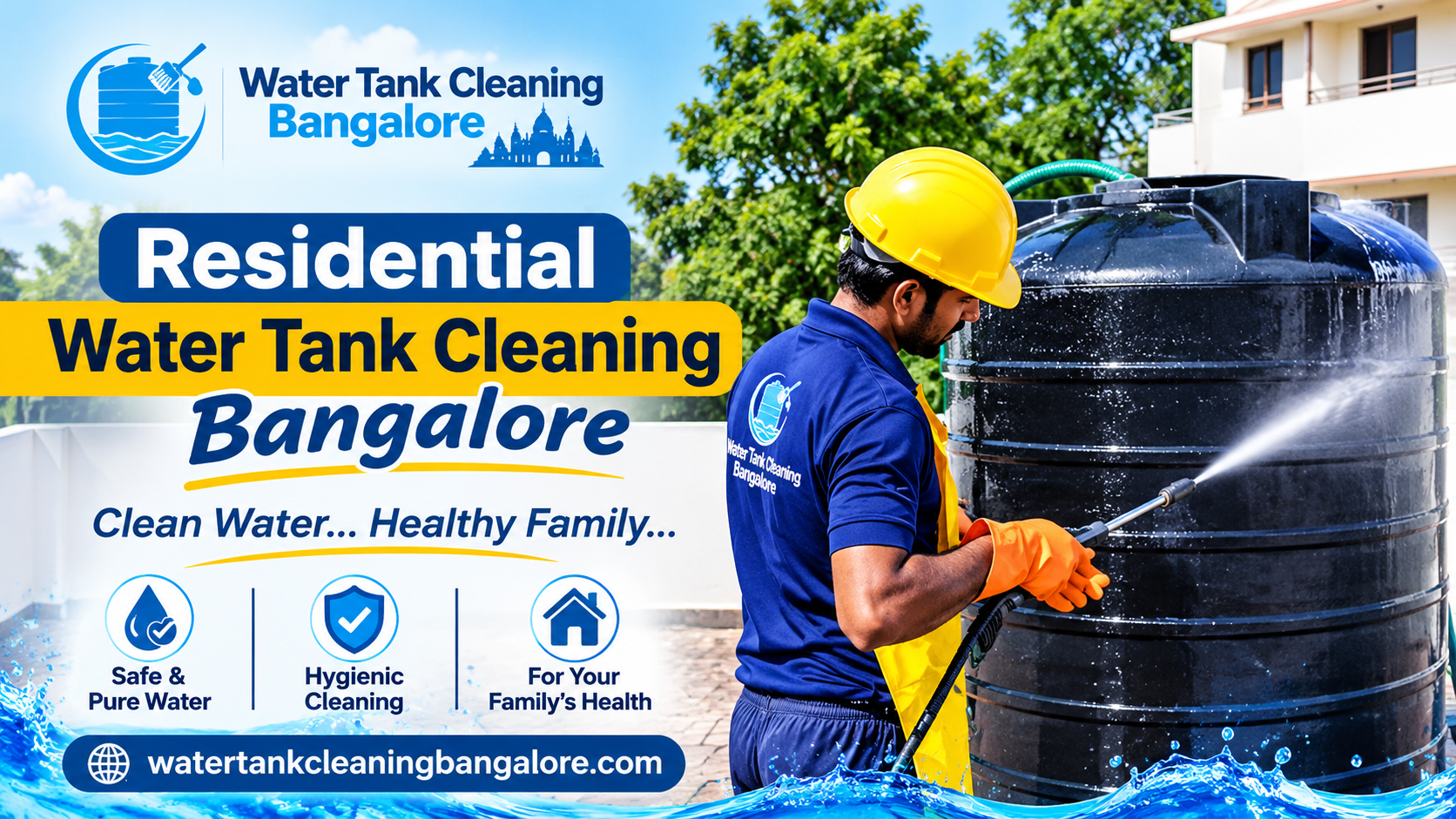
Residential Water Tank Cleaning Bangalore: Professional Home Water Tank Cleaning Services
Clean water is one of the most important requirements for a healthy home. Every day, families depend on stored water for drinking, cooking, bathing, washing clothes, cleaning and other household activities. However, maintaining good water quality involves more than checking the incoming water supply. The condition of the water storage tank also plays an important role.
Over time, residential water tanks can collect mud, sand, dust, rust particles, algae, sludge and other unwanted deposits. These impurities may settle at the bottom of the tank or attach themselves to the internal walls. When cleaning is delayed, the accumulated deposits can affect the hygiene of the water storage system and create unpleasant smells, visible particles and other water quality concerns.
This is why professional residential water tank cleaning in Bangalore is an important part of regular home maintenance.
Whether you live in an independent house, villa, duplex or residential building, your water storage system requires periodic inspection and cleaning. Underground sumps and overhead tanks should both be maintained because they form part of the same household water supply system.
At Water Tank Cleaning Bangalore, we provide professional residential water tank cleaning services for individual houses, villas and residential properties across Bangalore. Our cleaning procedure focuses on removing accumulated sludge, scrubbing internal surfaces, using suitable pressure-cleaning equipment, rinsing away impurities and applying appropriate disinfection.
We understand that every home has different water storage requirements. A small rooftop plastic tank may require a different cleaning arrangement from a large underground concrete sump. Our service approach considers the tank type, capacity, accessibility and level of contamination.
If your household water tank has not been cleaned for several months, arranging professional maintenance can help maintain better water storage hygiene and reduce the accumulation of unwanted deposits.
What Is Residential Water Tank Cleaning?
Residential water tank cleaning is the process of removing accumulated dirt, sludge, sediment, algae and other unwanted deposits from water storage tanks used in homes.
Most independent houses and villas in Bangalore use one or more storage systems to maintain a regular water supply. These may include underground sumps, overhead tanks, rooftop plastic tanks and concrete storage reservoirs.
Although these tanks are designed to store water, they are not self-cleaning. Small quantities of suspended particles can enter with the incoming water and gradually settle at the bottom. Dust, insects and environmental debris may also enter through damaged or poorly fitted tank covers.
A professional residential tank cleaning service addresses these deposits through a structured procedure.
The cleaning process generally includes:
-
Initial inspection of the tank.
-
Controlled drainage of stored water.
-
Removal of mud, sludge and sediment.
-
Scrubbing of internal walls and floors.
-
High-pressure jet cleaning where appropriate.
-
Vacuum extraction of loosened dirt and wastewater.
-
Thorough rinsing.
-
Suitable disinfection.
-
Final inspection before the tank is returned to service.
The objective is to remove physical contamination and improve the hygiene of the water storage system.
Residential water tank cleaning is suitable for independent houses, villas, duplex homes, rented properties, small residential buildings and other domestic storage systems.
Why Is Residential Water Tank Cleaning Important for Every Home?
Many homeowners concentrate on maintaining kitchen filters, water purifiers and plumbing fixtures but overlook the condition of the main storage tank.
However, water stored inside an unmaintained tank may collect sediment and other unwanted deposits before it reaches household taps.
Regular cleaning is important for several reasons.
1. Removes Accumulated Mud and Sediment
Incoming water may carry small quantities of soil, sand and suspended particles.
These particles gradually settle at the bottom of the storage tank.
Over time, the deposits can become thicker and more difficult to remove.
Professional cleaning helps extract accumulated sediment and prevents existing deposits from remaining inside the tank.
2. Helps Maintain Water Storage Hygiene
A tank containing mud, organic debris and algae does not provide an ideal storage environment.
Cleaning the internal walls, floor and corners helps remove these unwanted deposits.
Appropriate disinfection after physical cleaning provides an additional step to reduce microbial contamination.
3. Helps Address Unpleasant Water Odours
If water develops an unusual or unpleasant smell, accumulated organic material, biofilm or contamination may be contributing factors.
Cleaning and disinfecting the tank can help address some of these sources.
If the smell continues, the incoming supply and connected plumbing should also be checked.
4. Reduces Algae and Biofilm Accumulation
Algae may develop when suitable light, moisture and nutrient conditions are present.
Biofilm can also attach to wet surfaces inside the tank.
These deposits may remain on the walls and floor even after the water has been drained.
Proper scrubbing followed by appropriate disinfection helps address this problem.
5. Helps Reduce Sediment Entering Household Pipelines
When accumulated deposits become disturbed during water filling or pumping, some particles may enter the connected plumbing system.
Regular cleaning helps reduce the amount of settled material available to be disturbed.
6. Supports Better Household Maintenance
A residential water tank is an important part of the home's plumbing infrastructure.
Periodic maintenance helps homeowners identify sediment buildup, damaged covers, cracks, leaks and other problems.
Addressing these issues early can make future maintenance easier.
7. Provides Greater Confidence in Water Storage Conditions
A clean and properly maintained storage tank helps provide a more hygienic environment for storing water.
However, visible cleanliness does not establish that water is safe for drinking. Where water quality is uncertain, appropriate testing and treatment are necessary.
Common Types of Residential Water Tanks in Bangalore Homes
Residential water storage systems differ according to building design, household size, available space and water supply arrangements.
Understanding the type of tank installed in your home helps determine the appropriate cleaning procedure.
1. Underground Water Tanks
Underground water tanks, commonly called sumps, are widely used in independent houses and villas.
They generally receive water from municipal connections, borewells or private water tankers.
The stored water is then pumped to the overhead tank.
Because these sumps receive incoming water directly, they can collect considerable quantities of mud, sand and sediment over time.
Professional underground water tank cleaning helps remove these deposits and clean the internal surfaces.
2. Overhead Water Tanks
Overhead tanks are installed on rooftops, terraces or elevated platforms.
They store water before it is distributed to household outlets.
Common overhead tank materials include plastic, reinforced concrete and other suitable storage materials.
Dust, algae, sediment and other impurities may accumulate if the tank is not maintained properly.
Regular cleaning helps maintain the hygiene of these storage systems.
3. Plastic Water Tanks
Plastic water tanks are commonly installed in independent houses and villas.
They are available in different capacities and are relatively convenient to maintain.
However, plastic tanks can still collect algae, dirt and sediment.
Cleaning should use suitable tools and pressure settings to avoid scratching or damaging the tank surface.
4. Concrete Water Tanks
Concrete tanks are frequently used for underground storage and larger residential properties.
Their internal surfaces may develop deposits, scale and other contaminants over time.
Cracks, damaged plaster and waterproofing problems should also be checked during inspection.
The cleaning method should be selected according to the concrete surface condition.
5. Stainless Steel Water Tanks
Some residential properties use stainless steel storage tanks.
These tanks also require periodic inspection and cleaning.
Appropriate non-damaging cleaning methods should be selected to protect the surface and avoid introducing unsuitable chemicals.
6. Terrace Water Storage Tanks
Terrace tanks are exposed to environmental conditions such as dust, sunlight and temperature changes.
If covers are damaged or access openings are not secured, external contaminants may enter.
Periodic cleaning and cover inspection help maintain better storage hygiene.
Signs Your Residential Water Tank Needs Cleaning
A water tank does not always show visible signs of contamination from outside.
However, certain changes in the stored water or tank condition indicate that inspection and cleaning may be necessary.
1. Muddy or Cloudy Water
If the water coming from household taps appears cloudy or contains visible particles, the storage system should be inspected.
Sediment may have entered from the supply source or accumulated inside the tank.
2. Unpleasant Smell
An unusual smell may indicate organic deposits, microbial activity or contamination elsewhere in the water supply system.
A tank inspection can help identify whether cleaning is required.
3. Green Deposits Inside the Tank
Green patches or slippery deposits may indicate algae or biofilm formation.
These should be physically removed through suitable cleaning methods.
4. Sand and Mud at the Bottom
Visible sediment at the bottom of a tank is a clear indication that cleaning should be considered.
Leaving these deposits for extended periods may make future cleaning more difficult.
5. Brown or Yellow Discolouration
Brown or yellowish deposits may be associated with rust particles, soil, minerals or other impurities.
The cause should be investigated rather than assuming that tank cleaning alone will solve the problem.
6. Dead Insects or Leaves
A damaged or uncovered tank may allow insects, leaves and other debris to enter.
These materials should be removed promptly and the tank cover should be repaired or replaced where necessary.
7. Long Time Since the Last Cleaning
Even if the water looks clear, sediment may be settling at the bottom.
If you cannot remember the last time your tank was cleaned, arranging an inspection is a sensible step.
Our Residential Water Tank Cleaning Process in Bangalore
At Water Tank Cleaning Bangalore, we follow a systematic approach to residential tank cleaning.
The exact cleaning method depends on the tank size, construction, contamination level and accessibility.
Step 1: Initial Tank Inspection
Before starting the cleaning work, the tank is inspected to understand its condition.
The assessment considers:
-
Type of tank.
-
Approximate storage capacity.
-
Tank material.
-
Visible sediment accumulation.
-
Algae and surface deposits.
-
Accessibility.
-
Inlet and outlet arrangements.
-
Cleaning equipment requirements.
-
Site-specific safety concerns.
This helps determine the appropriate procedure for the property.
Step 2: Controlled Water Drainage
The existing water is drained using suitable equipment.
Removing the water exposes the tank floor and internal walls for cleaning.
For homes that depend on stored water throughout the day, the cleaning schedule can be planned according to household requirements.
Homeowners should ensure that adequate water is available for essential activities before the cleaning begins.
Step 3: Sludge and Sediment Removal
After drainage, accumulated sludge is removed from the tank floor.
Depending on the amount and thickness of the deposits, technicians use suitable manual or mechanical extraction methods.
Common materials removed include:
-
Mud and soil.
-
Sand and silt.
-
Rust particles.
-
Dead algae.
-
Organic debris.
-
Accumulated dirt.
This stage is particularly important for underground sumps that receive water from external sources.
Step 4: Internal Wall and Floor Scrubbing
Once the main sediment deposits are removed, the tank's internal surfaces are cleaned.
Walls, floors, corners and accessible sections may contain attached dirt and biofilm.
Suitable brushes and cleaning equipment are selected according to the tank material.
Care is taken to avoid unnecessary damage to plastic surfaces, concrete coatings or waterproofing layers.
Step 5: High-Pressure Jet Cleaning
High-pressure water jet cleaning helps loosen stubborn deposits from internal surfaces.
It is useful for removing dirt and algae that remain attached after initial scrubbing.
The pressure is selected according to the tank material and condition.
The objective is to clean the surface without damaging the structure.
Step 6: Vacuum Extraction
Where required, vacuum equipment is used to remove loosened sludge, slurry and residual wastewater.
This helps extract dirt from the bottom of the tank and difficult-to-reach areas.
Proper removal of cleaning waste is important to prevent the deposits from spreading around the property.
Step 7: Rinsing and Disinfection
After physical cleaning, the tank is rinsed thoroughly.
An appropriate disinfectant is then applied according to the product instructions and intended water use.
For tanks storing water intended for drinking, the disinfectant must be suitable for potable-water applications.
Correct concentration, contact time and any necessary rinsing or flushing instructions should be followed.
Step 8: Final Inspection and Handover
Before the tank is returned to service, its internal condition is checked.
The inspection focuses on remaining visible deposits, cleaning residue and any maintenance concerns identified during the work.
The tank can then be refilled according to the agreed procedure.
Where contamination is suspected, appropriate water testing should be considered before using the water for drinking.
Residential Sump Cleaning Services Bangalore
An underground sump is an important part of many residential water supply systems.
It stores incoming water before it is pumped to the overhead tank.
Because of its location and function, a sump may collect substantial quantities of sediment over time.
Why Residential Sumps Require Regular Cleaning
Residential sumps may collect:
-
Sand and mud from incoming water.
-
Silt and suspended particles.
-
Rust deposits from connected plumbing.
-
Algae and organic material.
-
Dust entering through damaged covers.
-
Other settled impurities.
If these deposits are not removed, they can accumulate at the bottom and affect the hygiene of the storage system.
Professional Residential Sump Cleaning
Our residential sump cleaning approach includes controlled drainage, sediment extraction, internal scrubbing, suitable pressure cleaning, rinsing and appropriate disinfection.
Underground tanks require particular safety attention.
They may present confined-space hazards due to restricted access, inadequate ventilation and potentially unsafe atmospheric conditions.
Entry must not be attempted without appropriate risk assessment, trained personnel, atmospheric monitoring where necessary and emergency arrangements.
Where possible, equipment-based cleaning methods that avoid unnecessary human entry should be preferred.
Overhead Water Tank Cleaning for Homes and Villas
Overhead water tanks are essential for distributing stored water throughout residential properties.
They may be installed on rooftops, terraces or elevated platforms.
Although these tanks are often covered, they can still accumulate dirt and other deposits.
Common Overhead Tank Contaminants
-
Dust and environmental debris.
-
Algae and biofilm.
-
Mud and sediment.
-
Rust particles.
-
Dead insects.
-
Organic deposits.
Why Professional Overhead Tank Cleaning Matters
An overhead tank supplies water to multiple household outlets.
If it is poorly maintained, accumulated deposits may affect the stored water and connected plumbing.
Professional cleaning helps remove these deposits and maintain a cleaner storage environment.
Cleaning Different Overhead Tank Materials
Plastic tanks should be cleaned using suitable brushes and controlled water pressure.
Concrete tanks require methods that account for the surface condition and protective coatings.
Stainless steel tanks should be cleaned using products and tools compatible with the material.
Selecting the right method helps avoid unnecessary damage during cleaning.
Villa Water Tank Cleaning Services in Bangalore
Villas often have larger storage systems than smaller independent houses.
Some properties have multiple overhead tanks, underground sumps and separate water storage arrangements for different parts of the building.
These systems require coordinated maintenance.
Common Villa Water Tank Problems
Villa tanks may experience:
-
Heavy sediment accumulation.
-
Algae growth.
-
Organic deposits.
-
Dust entering through tank covers.
-
Rust particles.
-
Inadequate cleaning intervals.
Our Villa Tank Cleaning Approach
We assess the number of tanks, their capacity, construction and accessibility before recommending the cleaning arrangement.
The work may include:
-
Inspection of all accessible storage tanks.
-
Controlled water drainage.
-
Sludge and sediment removal.
-
Internal scrubbing.
-
High-pressure jet cleaning where suitable.
-
Vacuum extraction.
-
Rinsing and disinfection.
-
Final inspection.
For properties with several tanks, coordinating the work during one scheduled visit may help reduce disruption.
Residential Water Tank Cleaning for Independent Houses
Independent houses often have one underground sump and one overhead tank.
The sump receives incoming water, while the overhead tank stores water for household distribution.
Both tanks require attention because cleaning only one part of the system may leave deposits in the other.
Benefits of Cleaning Both Tanks
Cleaning the underground sump helps remove sediment entering with the incoming water.
Cleaning the overhead tank addresses deposits that may accumulate before water reaches household outlets.
Maintaining both tanks as part of a coordinated schedule helps improve overall water storage hygiene.
Cleaning for Small and Large Homes
A smaller home may have a single plastic overhead tank.
A larger independent property may have multiple tanks with different capacities.
The cleaning procedure and equipment should be selected according to the actual installation rather than applying the same method to every property.
Residential Water Tank Cleaning for Duplex and Multi-Storey Homes
Duplex and multi-storey homes may have more complex plumbing and storage arrangements.
They may use multiple overhead tanks or interconnected storage systems.
The cleaning schedule should consider how water moves between the tanks and which areas of the property depend on each storage unit.
A professional inspection helps identify the tanks that need cleaning and allows the work to be coordinated.
This is especially useful when homeowners want to minimise water supply interruptions during the cleaning process.
How Often Should Residential Water Tanks Be Cleaned in Bangalore?
Cleaning frequency depends on the water source, tank condition, household usage and the amount of sediment entering the storage system.
For many residential homes, cleaning every three to six months is a practical starting point.
Properties with higher sediment levels or recurring contamination concerns may require more frequent inspection.
The following table provides a general maintenance guide.
| Residential property type | Suggested cleaning interval |
|---|---|
| Independent houses | Every 3–6 months |
| Villas | Every 3–6 months |
| Duplex homes | Every 3–6 months |
| Small residential buildings | Every 3–6 months |
| Homes using tanker water frequently | Based on sediment inspection |
| Homes with recurring algae problems | More frequent inspection |
| Homes with contamination concerns | Prompt inspection and cleaning |
These are general planning recommendations rather than universal legal requirements.
The cleaning schedule should be adjusted according to actual tank conditions and water quality.
Why Bangalore Homes Need Periodic Tank Maintenance
Bangalore households may depend on municipal water, borewell water or tanker supply.
The amount of sediment entering the tank can vary depending on the source and supply conditions.
Tanker deliveries and changing supply arrangements may introduce additional particles.
Regular inspection helps identify these changes before deposits accumulate excessively.
DIY Residential Water Tank Cleaning vs Professional Services
Some homeowners prefer to clean their tanks themselves using brushes, buckets and household cleaning materials.
While basic external maintenance can be handled by homeowners, deep tank cleaning involves additional equipment and safety requirements.
Limitations of DIY Tank Cleaning
1. Incomplete sludge removal
Thick sediment can remain attached to tank floors and corners.
2. Difficulty removing biofilm
Algae and biofilm may remain attached to the internal walls even after draining the water.
3. Lack of suitable equipment
Household tools may not be sufficient for larger sumps and tanks.
4. Incorrect chemical usage
Using unsuitable disinfectants or incorrect concentrations can create water quality problems.
5. Safety concerns
Underground sumps may present serious confined-space hazards, while rooftop cleaning involves working at height.
Advantages of Professional Residential Tank Cleaning
Professional cleaning provides access to suitable equipment and a structured procedure.
Depending on the tank requirements, this may include:
-
Drainage pumps.
-
Sludge extraction equipment.
-
Professional scrubbing tools.
-
High-pressure jet machines.
-
Vacuum extraction equipment.
-
Suitable disinfectants.
-
Personal protective equipment.
-
Final inspection procedures.
Professional services are particularly useful for underground sumps, large rooftop tanks and residential properties with multiple storage systems.
Factors Affecting Residential Water Tank Cleaning Cost in Bangalore
The cost of residential water tank cleaning depends on several factors.
A small overhead tank with light sediment requires a different amount of work compared with a large underground sump containing thick sludge.
The following factors generally influence the quotation.
1. Tank Capacity
Larger tanks usually require more time, labour and cleaning resources.
2. Type of Tank
Overhead tanks, underground sumps, plastic tanks and concrete tanks have different cleaning requirements.
3. Level of Contamination
A tank containing a small amount of dust and sediment may require less work than one with heavy sludge and algae buildup.
4. Accessibility
Rooftop height, access openings, underground construction and available working space may affect the equipment and manpower required.
5. Number of Tanks
Homes with multiple sumps and overhead tanks may require additional cleaning time.
6. Cleaning Method
The cleaning procedure may involve pressure washing, vacuum extraction, additional scrubbing and disinfection.
7. Additional Maintenance Requirements
Damaged tank covers, visible cracks, leaking connections and other structural issues may require separate repair work.
For an accurate quotation, homeowners should share the tank type, approximate capacity, number of tanks and property location.
How to Maintain a Clean Water Tank After Professional Cleaning
Professional cleaning removes existing deposits, but regular maintenance is necessary to reduce future contamination.
Homeowners can follow these simple practices.
1. Keep the Tank Cover Secure
A properly fitted cover prevents dust, leaves, insects and other external materials from entering the tank.
Inspect the cover periodically for cracks and damage.
2. Check the Incoming Water Supply
Monitor the condition of incoming water.
If visible sediment is repeatedly entering the tank, investigate the source and consider suitable filtration or other treatment arrangements.
3. Inspect the Tank Periodically
Check for visible algae, sediment, unusual smells and other changes.
Periodic inspection helps identify problems before they become more serious.
4. Maintain Connected Pipelines
Damaged or corroded pipes can introduce additional particles into the storage system.
Inspect inlet connections, valves and plumbing fittings.
5. Avoid Unapproved Cleaning Chemicals
Never use household cleaning products inside a drinking-water storage tank unless they are specifically suitable for that application.
Do not mix bleach with acids, ammonia or other chemicals.
6. Keep a Tank Cleaning Record
Record the date of the last cleaning, tank condition and next planned maintenance date.
This makes it easier to maintain a consistent schedule.
7. Arrange Cleaning When Contamination Is Suspected
Do not wait for the next scheduled maintenance date if the water develops an unusual smell, colour or visible sediment.
Arrange an inspection and investigate the source of the problem.
Residential Water Tank Cleaning Services Across Bangalore
Water Tank Cleaning Bangalore provides residential tank cleaning services for individual houses, villas and domestic properties across Bangalore.
Our service coverage includes several established residential localities.
East Bangalore
-
Whitefield.
-
Marathahalli.
-
Bellandur.
-
KR Puram.
-
Hegde Nagar.
-
Electronic City.
North Bangalore
-
Hebbal.
-
Yelahanka.
-
RT Nagar.
-
Jalahalli.
-
Nearby residential layouts.
South Bangalore
-
JP Nagar.
-
BTM Layout.
-
Electronic City.
-
Surrounding residential areas.
West and Central Bangalore
-
Rajajinagar.
-
Established residential neighbourhoods.
-
Other nearby areas of Bangalore.
Availability depends on the property location, technician schedule and cleaning requirements.
Whether you need cleaning for one overhead tank, an underground sump or multiple residential storage systems, contact our team to discuss the service.
Why Choose Water Tank Cleaning Bangalore for Residential Tank Cleaning?
Choosing a professional service provider is important because tank cleaning requires appropriate equipment, cleaning methods and safety practices.
At Water Tank Cleaning Bangalore, we focus on providing systematic cleaning services for residential water storage systems.
Residential Cleaning Expertise
Our services cover independent houses, villas and other residential properties.
Suitable Cleaning Equipment
We use professional cleaning equipment, including high-pressure jet machines and vacuum extraction where required.
Complete Cleaning Approach
Our process focuses on removing sludge, cleaning internal surfaces, rinsing and applying appropriate disinfection.
Different Tank Types
We handle cleaning enquiries for overhead tanks, underground sumps and other residential storage systems.
Trained Technicians
Our cleaning team uses appropriate equipment and safety practices for the work being carried out.
Hygienic Cleaning Practices
We focus on removing visible deposits and addressing internal surface contamination.
Clear Pricing
The quotation is based on tank capacity, contamination level, accessibility and cleaning requirements.
Local Bangalore Service
We serve residential customers across several Bangalore localities, subject to scheduling and availability.
Convenient Booking
Homeowners can contact our team by phone or through the website to discuss their requirements and arrange a convenient cleaning schedule.
Our objective is to help households maintain cleaner water storage systems through careful and professional tank cleaning.
Frequently Asked Questions About Residential Water Tank Cleaning Bangalore
1. Why is residential water tank cleaning necessary?
Residential water tank cleaning removes accumulated mud, sand, sludge, algae and other deposits. It helps maintain better storage hygiene and reduces the buildup of unwanted material inside household water systems.
2. How often should I clean my home water tank in Bangalore?
For many residential properties, cleaning every three to six months is a practical starting point. The frequency depends on water source, sediment accumulation, tank condition and household usage.
3. Do you provide residential sump cleaning in Bangalore?
Yes. Water Tank Cleaning Bangalore provides residential sump cleaning services for independent houses and villas. The process can include drainage, sludge extraction, scrubbing, rinsing and suitable disinfection.
4. Do you clean overhead water tanks in homes?
Yes. Residential overhead tanks can be cleaned using suitable methods according to their size, material and contamination level.
5. Can plastic water tanks be cleaned professionally?
Yes. Plastic tanks can be cleaned using suitable brushes, controlled water pressure and compatible cleaning products. The method should avoid unnecessary scratching or surface damage.
6. Can concrete water tanks be cleaned?
Yes. Concrete tanks can be cleaned using suitable equipment and procedures. The surface condition, coatings and waterproofing should be considered before selecting the cleaning method.
7. What is included in residential water tank cleaning?
A comprehensive cleaning service may include inspection, drainage, sludge removal, internal scrubbing, pressure washing, vacuum extraction, rinsing and appropriate disinfection.
8. How long does residential water tank cleaning take?
The time depends on tank capacity, contamination level and accessibility. A residential overhead tank generally requires less time than a large underground sump.
9. Is disinfection included in residential tank cleaning?
Disinfection may be included as part of the cleaning service. The product and application procedure should be suitable for the intended water use.
10. Can I use the water immediately after cleaning?
The tank should only be returned to service after the cleaning and disinfection procedure is completed, including any required contact time, rinsing and flushing. For drinking-water concerns, appropriate testing is recommended.
11. What happens if I do not clean my water tank regularly?
Sediment, algae, organic deposits and other contaminants may accumulate. This can affect the appearance, smell and hygiene of stored water and may contribute to plumbing maintenance problems.
12. Do you provide water tank cleaning for villas?
Yes. We accept residential cleaning enquiries for villas with overhead tanks, underground sumps and multiple storage systems.
13. Is underground sump cleaning different from overhead tank cleaning?
Yes. Underground sumps generally require different access arrangements and may contain heavier sediment. Overhead tanks require additional attention to rooftop access and working-at-height safety.
14. Does tank cleaning remove bacteria?
Physical cleaning removes dirt and deposits, while appropriate disinfection can reduce microorganisms. Neither should be treated as proof that all water contamination has been eliminated.
15. How much does residential water tank cleaning cost in Bangalore?
The price depends on tank capacity, type, contamination level, accessibility and cleaning requirements. Contact our team with your tank details for a quotation.
16. Do I need to empty the tank before the cleaning team arrives?
The service team generally drains the stored water as part of the cleaning procedure. You should inform the team about the tank capacity and current water level before scheduling.
17. Can I book cleaning for both the sump and overhead tank?
Yes. Both tanks can be scheduled for cleaning during the same visit, depending on their accessibility, capacity and the service schedule.
18. Do you provide residential water tank cleaning in Whitefield and Electronic City?
Service enquiries are accepted from Whitefield, Electronic City and other Bangalore residential localities. Contact the team to confirm availability for your address.
19. Is professional tank cleaning better than DIY cleaning?
Professional cleaning offers suitable equipment and a structured approach to sludge removal, surface cleaning and disinfection. It is particularly useful for large tanks and underground sumps.
20. How can I book residential water tank cleaning in Bangalore?
You can call Water Tank Cleaning Bangalore at +91 99018 37838 or visit the official website to discuss your tank capacity, type and location and arrange a suitable service appointment.
Book Professional Residential Water Tank Cleaning in Bangalore
Your home's water storage system deserves regular attention.
Mud, sludge, algae, sand and other unwanted deposits can accumulate inside residential water tanks even when the incoming water appears clean. Without periodic maintenance, these deposits may affect the hygiene of the storage system and create unnecessary water quality concerns.
Professional residential water tank cleaning in Bangalore helps remove accumulated impurities through controlled drainage, sludge extraction, internal scrubbing, suitable pressure cleaning, rinsing and appropriate disinfection.
At Water Tank Cleaning Bangalore, we provide residential water tank cleaning solutions for independent houses, villas, duplex homes and other domestic properties.
Whether you need overhead tank cleaning, underground sump cleaning or complete residential water storage maintenance, our team can help assess your requirements.
Do not wait until your stored water develops an unusual smell or visible sediment. Plan regular cleaning and maintain a better water storage environment for your household.