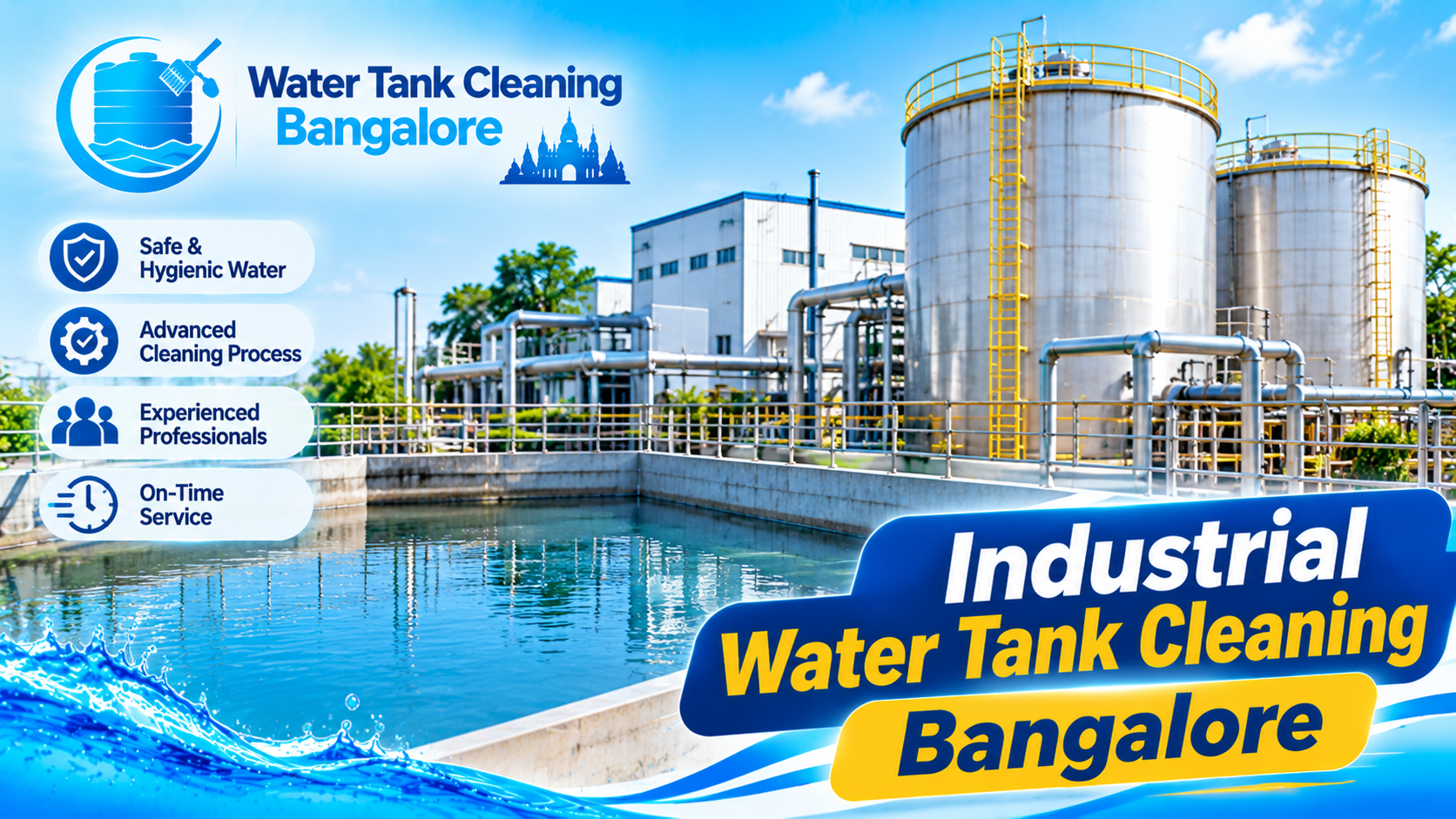
Industrial Water Tank Cleaning Bangalore
Industrial Water Tank Cleaning Bangalore: Professional Cleaning for Factories, Manufacturing Plants and Industrial Facilities
Water is an important resource for industrial operations. Manufacturing plants, factories, warehouses, processing units and corporate facilities depend on stored water for production support, equipment operations, cleaning, sanitation and employee requirements. Maintaining these water storage systems is therefore an important part of industrial facility management.
However, industrial water tanks can gradually collect sludge, sand, rust particles, mineral deposits, algae, organic matter and other unwanted materials. The type and quantity of deposits depend on the incoming water source, tank construction, storage conditions and intended use of the water.
When tanks are not maintained regularly, accumulated deposits can affect storage hygiene, create maintenance concerns and interfere with certain water distribution systems.
Professional industrial water tank cleaning in Bangalore helps businesses maintain their underground sumps, overhead tanks, process water tanks and other suitable storage facilities through planned inspection, sludge removal, washing, rinsing and appropriate disinfection.
Whether you manage a manufacturing unit in Peenya, a factory near Electronic City, a processing facility in an industrial estate or a large corporate campus, regular water tank maintenance should be part of your facility management plan.
This guide explains why industrial tank cleaning is important, the types of tanks that require attention, the professional cleaning process, safety requirements, maintenance frequency and how to choose a suitable industrial tank cleaning company in Bangalore.
Why Industrial Water Tank Cleaning Is Important
Industrial properties often use large-capacity tanks to store water for different purposes. These tanks may operate continuously and supply multiple sections of a facility.
Unlike a small household tank, an industrial storage system may have several connected tanks, pumps, pipelines and distribution points.
Regular maintenance is important for several reasons.
1. Removes Accumulated Sludge and Sediment
Water entering industrial storage tanks may contain suspended particles such as sand, mud and other sediments.
These materials gradually settle at the bottom of the tank and can form thick deposits.
Industrial facilities that receive water from tankers, borewells or other sources may experience varying levels of sediment accumulation.
Professional cleaning helps remove these deposits from accessible tank surfaces and floors.
2. Supports Better Water Storage Hygiene
Dirt, organic material and deposits can contribute to poor storage conditions.
Cleaning helps remove visible contamination and prepares suitable tanks for appropriate disinfection.
This is especially important for industrial properties that maintain separate storage systems for employee facilities, sanitation and other general-purpose requirements.
However, cleaning does not automatically make water suitable for drinking or industrial processes. Water quality depends on the source, treatment and intended application. Appropriate testing should be arranged when water quality verification is required.
3. Helps Reduce Sediment Entering Connected Equipment
Deposits inside a tank can sometimes enter connected outlets, pipes and pumping systems.
This may contribute to sediment accumulation around filters, valves, pump connections and other components.
Removing deposits from the storage tank helps reduce one potential source of unwanted material entering the distribution system.
It also provides an opportunity to inspect accessible tank components and identify visible maintenance issues.
4. Helps Address Rust and Mineral Deposits
Some industrial tanks may develop rust particles or mineral deposits depending on their material, water chemistry and operating conditions.
These deposits should be assessed before selecting a cleaning method.
Appropriate mechanical cleaning can remove suitable surface deposits, while more serious corrosion or coating damage may require separate repair or specialist treatment.
5. Supports Operational Planning
A poorly maintained tank can create unexpected maintenance work, particularly when sediment accumulation or water quality concerns are discovered during normal operations.
Scheduled inspections and cleaning help facility managers plan maintenance in advance.
A documented programme also makes it easier to coordinate cleaning with production schedules and other maintenance activities.
6. Helps Maintain Workplace Hygiene
Factories and industrial facilities use water for employee washrooms, housekeeping and general workplace requirements.
Maintaining suitable storage hygiene is part of responsible facility management.
Regular cleaning, appropriate disinfection and water quality monitoring help businesses manage these systems more effectively.
Types of Industrial Water Tanks That Require Cleaning
Industrial facilities may use several types of storage systems. The cleaning procedure must be selected according to each tank's purpose, construction and contents.
1. Underground Industrial Water Sumps
Underground sumps are commonly used to store incoming water for factories and manufacturing facilities.
They may supply overhead tanks, general-purpose water outlets and other connected systems.
Over time, underground sumps can collect:
-
Mud and sand
-
Sludge and sediment
-
Rust particles
-
Organic deposits
-
Mineral accumulation
-
Other suspended material
Because these tanks may have large capacities and restricted access, cleaning requires suitable equipment and careful safety planning.
2. Industrial Overhead Water Tanks
Overhead tanks are generally installed on rooftops or elevated structures.
They store water for distribution to different departments, floors or sections of a facility.
Dust, sediment and deposits may accumulate inside these tanks if they are not inspected and maintained regularly.
Cleaning should include suitable access arrangements and precautions for working at height.
3. Process Water Storage Tanks
Manufacturing facilities may use dedicated tanks for process water.
The stored water may have specific chemical, temperature or quality requirements depending on the production activity.
The cleaning method must be compatible with the tank material and the intended process.
If a tank contains process chemicals, oils or industrial residues, it should not be treated as an ordinary potable-water tank. A separate risk assessment and suitable industrial cleaning procedure are necessary.
4. Cooling Tower Water Tanks
Cooling systems often use water storage and circulation arrangements that require regular maintenance.
These systems may accumulate mineral scale, sediment and biological deposits.
Cleaning should follow the cooling system manufacturer's recommendations and the facility's water treatment programme.
Cooling tower maintenance may also require separate treatment of associated basins, circulation lines and other components.
5. Boiler Feed Water Tanks
Boiler systems may use dedicated feedwater storage tanks.
The cleaning requirements depend on the boiler system, water treatment process and operating specifications.
Deposits inside these tanks should be assessed by qualified personnel before selecting the cleaning method.
Cleaning alone does not replace the water treatment and quality controls required for boiler operation.
6. Fire Water Storage Tanks
Industrial properties may maintain separate tanks for fire protection systems.
These tanks should be maintained according to the applicable fire safety design, inspection and maintenance requirements.
Any cleaning work must be coordinated with the facility's fire safety team to ensure that required fire protection arrangements remain available or that approved temporary arrangements are implemented.
7. Rainwater Harvesting Tanks
Some industrial properties collect rainwater for approved non-potable uses.
These storage tanks may accumulate leaves, dust, soil and other material carried by runoff.
Regular inspection and cleaning help maintain the system's intended operation.
8. Industrial Wastewater Holding Tanks
Wastewater tanks may contain process residues, chemicals, oils, suspended solids or other materials.
These are not ordinary water storage tanks.
Cleaning must be planned using a separate assessment of the tank contents, potential hazards, waste classification, worker protection and disposal requirements.
Industries That Need Professional Water Tank Cleaning in Bangalore
Industrial tank maintenance is relevant to many sectors.
Each facility has different water storage requirements, so the cleaning plan should reflect the nature of its operations.
1. Manufacturing Plants
Manufacturing plants may use stored water for production support, equipment cooling, cleaning and employee facilities.
Large storage tanks can collect sediment and other deposits over time.
Regular inspection and suitable cleaning help facility managers maintain the storage infrastructure.
2. Factories and Industrial Units
Factories often operate several water storage systems for different departments.
Some may store general-purpose water, while others support production or specialised equipment.
Each tank should be identified by its intended use before cleaning begins.
3. Food Processing Facilities
Food processing units require particular attention to water quality and hygiene.
Storage tanks supplying water for food-related activities must follow appropriate potable-water or process-water requirements.
Cleaning procedures should be coordinated with the facility's food safety and quality management teams.
Water testing should be carried out according to the relevant quality requirements.
4. Pharmaceutical Facilities
Pharmaceutical facilities may use different water grades and specialised treatment systems.
The cleaning procedure for a general utility tank is not necessarily suitable for purified water or other controlled water systems.
The facility's engineering, quality and validation teams should approve the cleaning method and any required post-cleaning verification.
5. IT Parks and Corporate Campuses
Large corporate campuses may have underground sumps and overhead tanks supplying office buildings, cafeterias, washrooms and common facilities.
Cleaning can be scheduled around employee occupancy and water demand.
A staged approach may help reduce disruption when separate storage systems are available.
6. Warehouses and Logistics Centres
Warehouses may use stored water for employee facilities, cleaning, sanitation and fire protection.
The facility manager should identify each tank's purpose and arrange maintenance accordingly.
7. Hospitals and Healthcare Facilities
Healthcare facilities need carefully managed water storage systems.
Cleaning should be coordinated with the hospital's engineering and infection prevention teams, taking account of operational requirements and water safety procedures.
8. Commercial and Industrial Complexes
Properties that combine offices, factories, warehouses and other facilities may have multiple water storage systems.
A coordinated maintenance plan helps ensure that each tank is included.
Professional Industrial Water Tank Cleaning Process
Industrial tank cleaning requires planning, appropriate equipment and a clear understanding of the tank's purpose.
The following stages describe a typical cleaning process for suitable general-purpose industrial water storage tanks. Specialised process tanks may require additional procedures.
Step 1: Site Inspection and Risk Assessment
The cleaning team should inspect the tank and surrounding work area before starting.
The assessment should consider:
-
Tank location
-
Tank capacity
-
Tank material
-
Intended use of stored water
-
Existing water level
-
Type of accumulated deposits
-
Access and ventilation
-
Connected pumps and pipelines
-
Electrical equipment
-
Chemical or process hazards
-
Confined-space and work-at-height risks
-
Wastewater handling requirements
This information helps determine the cleaning method, equipment and safety arrangements.
Step 2: Identify the Tank Contents and Purpose
The facility manager should confirm whether the tank stores potable water, general-purpose water, process water, cooling water or another type of liquid.
This distinction is essential.
A cleaning product suitable for a general water storage tank may not be appropriate for a specialised process system.
If the tank contains industrial chemicals or unknown residues, the work should be handled through a suitable industrial cleaning and waste management procedure.
Step 3: Plan Cleaning Around Operations
Industrial facilities may operate on fixed production schedules.
The cleaning team should coordinate with the plant manager and maintenance department to select a suitable time.
The plan should identify:
-
Cleaning start and completion times
-
Tanks to be cleaned
-
Production requirements
-
Backup water arrangements
-
Pump and valve isolation
-
Access permissions
-
Safety responsibilities
-
Waste disposal arrangements
Step 4: Isolate Relevant Connections
Before draining the tank, relevant water supply connections, pumps and connected equipment should be isolated where necessary.
This helps prevent unexpected water flow or equipment operation during the cleaning activity.
Isolation and restoration should be handled by authorised personnel following the site's procedures.
Step 5: Controlled Water Drainage
The remaining water is drained using suitable pumps and drainage arrangements.
The method should consider the type of stored water and any restrictions on discharge.
Water containing industrial process residues or chemicals must not be released into ordinary drains without confirming that the disposal method is permitted.
Step 6: Sludge and Sediment Removal
Accumulated sludge, sand, mud and other suitable deposits are removed from the tank floor.
Depending on the tank size and condition, mechanical scraping tools, manual equipment or suitable extraction systems may be used.
Removing loose deposits before washing helps make the next stage more effective.
Step 7: High-Pressure Hydro Jet Cleaning
Where appropriate for the tank material, pressure-washing equipment can be used to clean accessible internal surfaces.
This helps loosen dirt and deposits attached to the tank floor and walls.
Pressure settings should be selected carefully to avoid damaging concrete surfaces, coatings, liners or other tank components.
Specialised tanks may require different cleaning methods.
Step 8: Vacuum Slurry and Waste Extraction
The loosened sludge and wastewater are collected using suitable extraction equipment.
For larger tanks, vacuum extraction may help remove slurry from difficult-to-reach areas.
Waste must be handled according to its composition and applicable disposal requirements.
Step 9: Appropriate Disinfection or Treatment
For suitable water storage tanks, an appropriate disinfectant may be applied after physical cleaning.
The product must be compatible with the tank material and intended water use.
For process tanks, cooling systems or other specialised installations, the required treatment should follow the relevant engineering and operating procedures.
Step 10: Final Rinsing and Inspection
The tank is rinsed according to the cleaning procedure.
Accessible internal surfaces, outlets and visible components should be inspected.
The cleaning team should report any cracks, corrosion, damaged coatings, leaks or other defects identified during the work.
Step 11: Refill and Restore the System
After the required cleaning, rinsing and inspection stages, the tank can be returned to service according to the facility's procedure.
Relevant valves, pumps and connections should be restored by authorised personnel.
Where required, water quality testing should be completed before the system is used for its intended purpose.
Benefits of Hiring Professional Industrial Tank Cleaning Services
Industrial water storage systems are often too large or complex for routine in-house cleaning.
Professional support can help businesses organise the work more effectively.
Suitable Equipment for Large-Capacity Tanks
Industrial tanks may require high-capacity drainage pumps, pressure-washing systems, vacuum extraction and specialised tools.
Equipment should be selected according to tank size, construction and deposits.
Planned Cleaning for Multiple Tanks
A factory may have several tanks serving different operations.
A professional site assessment helps identify the work required for each tank rather than treating the entire facility as one storage system.
Better Maintenance Coordination
Cleaning can be coordinated with plant maintenance, production shutdowns and other planned work.
This helps reduce avoidable disruption.
Appropriate Cleaning Procedures
Different tanks require different methods.
A professional cleaning plan should distinguish between potable-water storage, general-purpose water, cooling systems and process tanks.
Attention to Worker Safety
Industrial tank cleaning may involve confined spaces, electrical equipment, chemical exposure and elevated work.
Suitable safety planning is essential.
Maintenance Documentation
Facility managers can record the cleaning date, tank identification, work performed, observations and any recommended repairs.
This helps maintain a useful maintenance history.
How Often Should Industrial Water Tanks Be Cleaned?
There is no single cleaning frequency suitable for every industrial tank.
The ideal schedule depends on several factors:
-
Type of water stored
-
Intended use of the water
-
Incoming water quality
-
Tank capacity
-
Operating conditions
-
Sediment accumulation
-
Tank construction
-
Previous maintenance history
-
Industry-specific quality requirements
-
Applicable regulations and internal procedures
For many general-purpose industrial storage tanks, a three-to-six-month inspection and cleaning planning interval can be a useful starting point.
However, specialised systems may need a different schedule based on manufacturer instructions, water treatment requirements and process controls.
Suggested Industrial Tank Maintenance Planning
| Facility or tank type | Maintenance approach |
|---|---|
| General factory water storage | Inspect regularly; consider cleaning every 3–6 months |
| Manufacturing plant sumps | Schedule according to sediment accumulation and usage |
| Corporate and IT facilities | Inspect regularly; consider cleaning every 3–6 months |
| Food processing water storage | Follow food safety and water quality procedures |
| Pharmaceutical water systems | Follow validated facility procedures and quality requirements |
| Cooling tower systems | Follow the water treatment and cooling system maintenance programme |
| Boiler feed water tanks | Follow boiler and water treatment specifications |
| Fire water tanks | Follow applicable fire protection inspection and maintenance requirements |
| Industrial wastewater tanks | Follow process-specific inspection, cleaning and waste handling procedures |
These are general planning guidelines, not universal regulatory intervals.
Why Regular Inspections Are Necessary
Some tanks accumulate sediment more quickly than others.
A tank receiving water with high suspended solids may need more frequent cleaning than one receiving treated water.
Similarly, a tank used for a specialised process may require monitoring beyond ordinary visual inspection.
Regular inspection helps facility managers decide when cleaning is necessary.
How Industrial Tank Cleaning Can Be Planned Without Major Production Disruption
Production continuity is a major concern for industrial facilities.
Cleaning should be planned so that essential water requirements are considered before any tank is drained.
1. Review Production and Maintenance Schedules
Coordinate cleaning with planned shutdowns, maintenance windows or periods of lower water demand.
This helps reduce the chance of interfering with production activities.
2. Identify Backup Water Storage
Check whether alternative tanks or temporary storage arrangements are available.
The facility manager should confirm that essential water requirements can be met during the cleaning period.
3. Clean Independent Tanks in Stages
If the facility has multiple independent storage systems, cleaning may be arranged one tank at a time.
This approach can help keep unaffected sections operational.
It should only be used where the plumbing and process design permit it.
4. Coordinate With Engineering and Maintenance Teams
The engineering team should identify relevant valves, pumps, pipelines and electrical connections.
Only authorised personnel should carry out equipment isolation and restoration.
5. Inform Relevant Departments
Production, maintenance, quality, safety and housekeeping teams should receive advance notice.
This is particularly important when the tank supplies water to several departments.
6. Verify the System Before Returning It to Service
Complete the required inspection, rinsing, testing and restoration procedures before using the tank again.
The acceptance criteria should reflect the intended water use.
Industrial Water Tank Cleaning Cost in Bangalore
The cost of industrial water tank cleaning depends on the size, condition and complexity of the storage system.
A small factory sump may require a different level of work from a large manufacturing plant with several high-capacity tanks.
The final quotation should be based on a site assessment and a clearly defined scope of work.
Factors That Affect Industrial Tank Cleaning Charges
1. Tank capacity
Larger tanks generally require more time, equipment and manpower.
2. Number of tanks
Facilities with multiple sumps, overhead tanks and process storage units may require staged cleaning or additional teams.
3. Type of deposits
Loose sediment is usually different from heavy sludge, scale, grease or process residue.
4. Tank construction
Concrete, steel, plastic and lined tanks may require different cleaning tools and methods.
5. Accessibility
Restricted underground access, elevated structures and difficult entry points can affect the work plan.
6. Type of stored material
General water storage, cooling water and industrial process liquids have different cleaning and waste management requirements.
7. Safety requirements
Confined-space controls, atmospheric testing, ventilation, work-at-height arrangements and other safety measures may influence the project scope.
8. Work schedule
Night shifts, weekend work and production shutdown coordination may affect the quotation.
9. Wastewater handling
The volume and nature of waste material can affect extraction, transportation and disposal requirements.
What Should an Industrial Cleaning Quotation Include?
Before approving the work, request clear information about:
-
Number of tanks included
-
Tank capacities and locations
-
Intended use of each tank
-
Cleaning method
-
Sludge removal procedure
-
Equipment and manpower
-
Disinfection or treatment requirements
-
Wastewater handling
-
Safety arrangements
-
Expected work duration
-
Production interruption, if any
-
Testing or inspection requirements
-
Additional charges
-
Final documentation
A detailed quotation helps facility managers compare providers and avoid unexpected costs.
Safety Requirements for Industrial Water Tank Cleaning
Safety is one of the most important parts of industrial tank cleaning.
Industrial facilities may contain confined spaces, electrical installations, chemical storage areas, elevated platforms and machinery.
The cleaning plan should identify hazards before work begins.
1. Confined-Space Safety
Underground sumps and certain industrial tanks may qualify as confined spaces.
They may contain oxygen-deficient or hazardous atmospheres, and entry can make emergency rescue difficult.
Entry should only occur after an appropriate risk assessment and implementation of suitable controls.
Depending on the tank and site, these controls may include:
-
Atmospheric testing
-
Ventilation
-
Isolation of connected equipment
-
Lockout and tagout procedures where applicable
-
Trained supervision
-
Communication arrangements
-
Suitable personal protective equipment
-
A documented rescue plan
-
Trained standby personnel
Workers should never enter an industrial tank without appropriate safety arrangements.
2. Chemical Exposure Prevention
Industrial tanks may contain chemical residues, cleaning products or process materials.
The facility should identify these substances before cleaning.
Suitable handling procedures, safety data sheets and personal protective equipment should be considered.
3. Electrical Safety
Pumps, cables and electrical equipment must be handled carefully around water.
Equipment should be isolated where required, and electrical work should only be performed by authorised personnel.
4. Working at Height
Overhead tanks may require rooftop access, ladders or elevated platforms.
Suitable access systems, fall protection and work-at-height precautions are essential.
5. Waste Handling and Disposal
Industrial cleaning waste may contain more than ordinary sludge.
Its composition should be assessed, and disposal must follow applicable environmental and waste management requirements.
Wastewater should not be discharged into ordinary drains without confirming that the disposal method is permitted.
6. Emergency Preparedness
The cleaning provider and facility management team should understand the emergency arrangements before starting work.
This is particularly important for confined-space activities and sites with hazardous materials.
How to Choose the Right Industrial Water Tank Cleaning Company in Bangalore
Choosing a suitable service provider is important for businesses with large or specialised water storage systems.
Consider the following factors before confirming a cleaning project.
Experience With Industrial Facilities
Ask whether the provider has experience working with factories, manufacturing units, corporate campuses and other large facilities.
Industrial properties often have more complex storage arrangements than residential buildings.
Understanding of Different Tank Types
The provider should understand the difference between general-purpose water tanks, potable-water storage, cooling systems and process tanks.
The cleaning method must suit the tank's purpose.
Appropriate Equipment
Check whether the company has suitable drainage pumps, pressure-washing equipment, sludge extraction systems and other tools for the project.
Safety Planning
Ask how the provider manages confined spaces, electrical isolation, elevated tanks and chemical exposure.
A clear safety plan is essential before work begins.
Transparent Quotation
The quotation should list the tanks included, cleaning stages, equipment, manpower, waste handling and additional charges.
Flexible Scheduling
The provider should be able to discuss a practical work schedule around production and maintenance requirements.
Clear Handover and Documentation
Ask whether the provider supplies basic service records and reports any visible tank defects.
If the facility needs water quality verification, arrange suitable laboratory testing separately or confirm that it is explicitly included in the scope.
Industrial Water Tank Cleaning Across Bangalore
Bangalore has several industrial and manufacturing areas where factories, warehouses, processing facilities and corporate campuses depend on stored water.
Industrial properties across the city can enquire about cleaning services based on their tank requirements.
Peenya Industrial Area
Peenya is a major industrial location with manufacturing units and engineering facilities.
Factories in this area may use underground sumps and other storage systems for general and operational water requirements.
Electronic City
Electronic City includes technology companies, business facilities and industrial establishments.
Large campuses may require planned cleaning for underground and overhead tanks.
Whitefield and Mahadevapura
These areas include corporate offices, technology parks, commercial buildings and mixed-use facilities.
Water storage maintenance can be coordinated with facility management teams.
Bommasandra and Jigani
Industrial facilities in these locations may have large storage systems supporting manufacturing and other operations.
Cleaning requirements should be assessed according to the intended water use.
Bidadi and Surrounding Industrial Areas
Manufacturing and industrial properties in and around Bidadi may use dedicated tanks for general, process and utility water.
The cleaning method should reflect the facility's storage design.
Other Bangalore Locations
Service enquiries can also be made from:
-
Marathahalli
-
Bellandur
-
KR Puram
-
Hebbal
-
Rajajinagar
-
Jalahalli
-
Yelahanka
-
BTM Layout
-
JP Nagar
-
Hegde Nagar
Confirm service availability for the exact industrial property location before scheduling work.
Industrial Water Tank Cleaning Services in Bangalore
Water Tank Cleaning Bangalore provides industrial and corporate tank cleaning services for factories, manufacturing units, IT parks, corporate campuses, hotels and other large facilities.
The service is intended for high-capacity storage systems and can include underground sumps, overhead tanks and suitable commercial or industrial water storage tanks.
The cleaning process may involve controlled drainage, sludge and sediment removal, scrubbing, pressure washing, vacuum extraction, rinsing, appropriate disinfection and final inspection.
The cleaning approach depends on the tank's construction, intended use, condition and site-specific safety requirements.
Industrial Cleaning Services Available
Industrial sump cleaning: Removal of accumulated sludge, sediment and deposits from suitable underground water storage systems.
Factory water tank cleaning: Planned cleaning for storage tanks serving factories and manufacturing facilities.
Industrial overhead tank cleaning: Cleaning arrangements for elevated storage tanks, with suitable access and work-at-height precautions.
Corporate campus tank cleaning: Cleaning for large office facilities, IT parks and business campuses.
Large-capacity water tank cleaning: Site-based cleaning plans for high-volume storage systems.
Industrial tank maintenance support: Inspection of accessible surfaces and reporting of visible maintenance concerns.
Why Contact Water Tank Cleaning Bangalore?
-
Industrial and corporate tank cleaning services
-
Underground sump cleaning
-
Overhead water tank cleaning
-
High-capacity storage tank cleaning
-
Professional cleaning equipment
-
Sludge and sediment removal
-
Pressure washing and suitable extraction methods
-
Appropriate disinfection for suitable water storage systems
-
Scheduling based on site requirements
-
Service enquiries across Bangalore
Book Industrial Water Tank Cleaning in Bangalore
If your factory or industrial facility needs professional tank cleaning, contact Water Tank Cleaning Bangalore to discuss the project requirements.
Share the following information when requesting a quotation:
-
Industrial property location
-
Number of tanks
-
Approximate capacity of each tank
-
Type of water stored
-
Tank construction
-
Current condition
-
Preferred cleaning schedule
Website: https://www.watertankcleaningbangalore.com/
Phone: +91 9901837838
Industrial Water Tank Maintenance Checklist
A structured checklist helps facility managers organise cleaning and inspection activities.
Before Cleaning
-
Identify every tank on the property.
-
Record tank capacity and location.
-
Confirm the intended use of stored water.
-
Check previous cleaning and maintenance records.
-
Assess the type of deposits or residues.
-
Review tank access and ventilation.
-
Identify connected pumps and valves.
-
Check production and backup water requirements.
-
Review confined-space and work-at-height hazards.
-
Confirm wastewater handling arrangements.
-
Approve the cleaning scope and schedule.
During Cleaning
-
Confirm that the agreed tanks are being serviced.
-
Verify that equipment isolation is completed where necessary.
-
Check that the required safety arrangements are in place.
-
Monitor sludge and sediment removal.
-
Confirm that the cleaning method suits the tank material.
-
Ensure wastewater is handled appropriately.
-
Confirm that any disinfection follows the agreed procedure.
-
Record visible defects or unusual findings.
After Cleaning
-
Confirm that cleaning and rinsing are complete.
-
Review the final inspection.
-
Confirm that the tank is ready for its intended use.
-
Restore equipment through authorised personnel.
-
Complete any required water quality testing.
-
Record the service date and work performed.
-
Retain relevant photographs and reports.
-
Arrange repairs for identified defects.
-
Schedule the next inspection.
Frequently Asked Questions About Industrial Water Tank Cleaning Bangalore
1. What is industrial water tank cleaning?
Industrial water tank cleaning is the removal of sludge, sediment, dirt, scale and other deposits from suitable water storage systems used in factories, manufacturing plants, warehouses and industrial facilities.
2. Why do factories need professional water tank cleaning?
Factories often use large storage tanks for general water requirements, production support and employee facilities. Professional cleaning helps remove accumulated deposits and supports better storage hygiene.
3. How often should industrial water tanks be cleaned?
A three-to-six-month interval can be a useful starting point for inspecting and planning cleaning for many general-purpose tanks. Specialised systems may require different schedules based on their intended use and operating requirements.
4. Do you provide industrial sump cleaning in Bangalore?
Yes. Industrial sump cleaning can be arranged for suitable underground storage tanks. The work may include controlled drainage, sludge removal, washing, rinsing and appropriate disinfection.
5. Can you clean large-capacity industrial tanks?
Large-capacity tank cleaning can be discussed after assessing the tank size, location, condition, access and safety requirements.
6. Do you clean overhead tanks in factories?
Yes. Industrial overhead tank cleaning can be arranged subject to access, construction and suitable work-at-height safety measures.
7. Can process water tanks be cleaned using the same method as drinking-water tanks?
Not necessarily. Process tanks may contain specific residues or have specialised water quality requirements. The cleaning procedure must be selected according to the process and tank contents.
8. Is industrial tank cleaning suitable for pharmaceutical facilities?
General storage tank cleaning may be suitable for some pharmaceutical facility tanks. Purified water and specialised systems require facility-approved procedures and appropriate quality verification.
9. Can cooling tower tanks be cleaned?
Cooling tower basins and associated storage systems require cleaning according to the cooling system's water treatment and maintenance programme.
10. How long does industrial tank cleaning take?
The duration depends on tank capacity, number of tanks, deposits, access, equipment and safety requirements. A site assessment helps establish a realistic work schedule.
11. Will industrial tank cleaning interrupt production?
Some work may require temporary water interruption. The facility should coordinate cleaning with production and maintenance teams and consider backup storage or staged cleaning where possible.
12. What equipment is used for industrial tank cleaning?
Depending on the project, equipment may include drainage pumps, mechanical cleaning tools, high-pressure washing systems and vacuum extraction units.
13. Does pressure washing remove all tank deposits?
Pressure washing can help loosen suitable surface deposits. Heavy scale, corrosion or specialised process residues may require different treatment methods.
14. Is disinfection included in industrial tank cleaning?
Appropriate disinfection may be included for suitable water storage tanks. Specialised process systems require their own approved treatment procedures.
15. How much does industrial water tank cleaning cost in Bangalore?
The cost depends on tank capacity, number of tanks, contamination level, access, equipment, manpower and waste handling. A site-specific quotation is recommended.
16. Is confined-space safety required for underground tank cleaning?
It may be required depending on the tank design and conditions. Entry should only occur after a suitable risk assessment and implementation of the required safety controls.
17. Can industrial tanks be cleaned during weekends?
Weekend or planned shutdown cleaning can be discussed with the service provider. Scheduling depends on site access, team availability and safety arrangements.
18. Do you clean tanks in Peenya Industrial Area?
Industrial facilities in Peenya can enquire about cleaning services. Confirm availability by sharing the property location and tank details.
19. Does cleaning guarantee that stored water is safe?
No. Cleaning removes deposits and supports better storage hygiene, but it does not certify water quality. Appropriate laboratory testing is necessary when water quality verification is required.
20. How can I book industrial water tank cleaning in Bangalore?
Contact Water Tank Cleaning Bangalore at +91 9901837838 or visit https://www.watertankcleaningbangalore.com/. Share your tank capacity, location, type of water stored and preferred date to discuss the service.
Conclusion: Maintain Industrial Water Storage With Professional Cleaning
Industrial water storage systems support important activities across factories, manufacturing plants, corporate campuses and processing facilities. Over time, these tanks can collect sludge, sediment, rust and other deposits that require planned maintenance.
Regular inspection and professional cleaning help remove suitable accumulated material, support better storage hygiene and identify visible tank defects.
For industrial facilities, the cleaning method must always match the tank's intended use. General-purpose storage, potable-water tanks, cooling systems and process tanks may require different procedures.
A well-planned maintenance programme also helps businesses coordinate cleaning with production schedules, manage water availability and maintain useful service records.
If your facility needs industrial water tank cleaning in Bangalore, choose a service provider that understands large storage systems, uses suitable equipment, follows appropriate safety procedures and clearly explains the scope of work.
Water Tank Cleaning Bangalore provides industrial and corporate tank cleaning services for factories, manufacturing units and large facilities.