apartment sump cleaning Bangalore
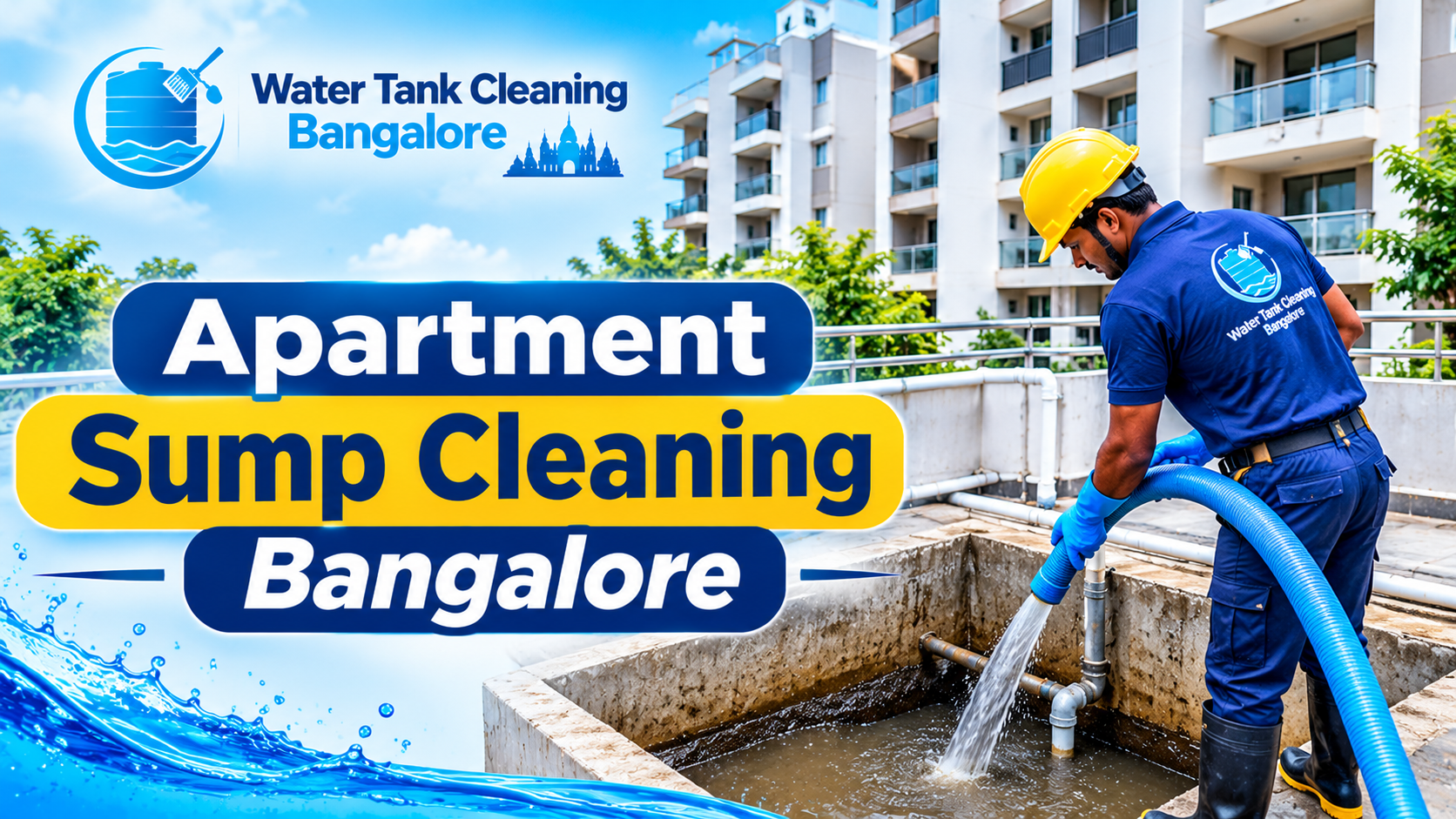
Apartment Sump Cleaning Bangalore – Professional Cleaning for Apartments and Housing Societies
Water storage is an essential part of every apartment building. In Bangalore, many residential communities depend on underground sumps to store water received from municipal supply, borewells and water tankers. This stored water is then pumped to overhead tanks and distributed to individual flats.
Although underground sumps are designed to store large quantities of water, they can gradually collect mud, sand, sludge, rust particles, algae and other unwanted deposits. These materials may settle at the bottom or stick to the internal walls. If the sump is not inspected and cleaned regularly, the accumulated deposits can affect the hygiene of the storage system.
Apartment sump cleaning in Bangalore is an important maintenance service for apartment associations, gated communities, resident welfare associations and facility management teams. Professional cleaning helps remove accumulated sludge and dirt through a planned process involving drainage, sediment extraction, internal scrubbing, washing, rinsing and appropriate disinfection.
Water Tank Cleaning Bangalore provides sump and water tank cleaning services for residential apartments, housing societies and other properties. The cleaning process is planned according to the sump's size, condition, accessibility and water storage requirements.
This guide explains why apartment sumps need regular cleaning, how professional sump cleaning works, what apartment associations should consider before booking a service, how often cleaning should be scheduled and how to maintain underground water storage systems.
What Is Apartment Sump Cleaning?
Apartment sump cleaning is the process of removing accumulated sludge, sediment, dirt and other deposits from underground water storage tanks in residential buildings.
A sump is generally constructed below ground level or within a building's basement. It receives and stores water before the water is pumped to overhead tanks or other distribution systems.
Unlike a small household tank, an apartment sump may serve dozens or hundreds of flats. It can have a large storage capacity and may receive water from different sources.
Over time, suspended particles settle at the bottom. Depending on the water source and storage conditions, deposits may include:
-
Sand and soil particles.
-
Mud and sediment.
-
Rust particles from connected plumbing.
-
Algae and organic deposits.
-
Slime and biofilm.
-
Dust and other external material.
-
Debris entering through damaged covers or openings.
Professional apartment sump cleaning removes these deposits from accessible internal surfaces and helps maintain a cleaner water storage environment.
The cleaning process may also include suitable disinfection after physical cleaning. Disinfection must be carried out using an appropriate product and procedure for the intended water use.
Why Is Apartment Sump Cleaning Important in Bangalore?
Bangalore apartment buildings often depend on a combination of municipal water, borewell water and private water tankers. The characteristics of incoming water can vary according to the source, supply conditions and season.
When water enters an underground sump, suspended particles may gradually settle. If the storage system is not maintained, the bottom and internal walls can accumulate deposits.
Regular sump cleaning is important for several reasons.
1. Removes Accumulated Sludge
Sludge is one of the most common problems in underground sumps. It can develop from sand, mud, rust particles and other suspended materials entering the tank.
A layer of sludge may build up at the bottom even when the water looks clear from the surface.
Normal water usage does not necessarily remove this material. In many cases, the sump must be drained and cleaned to remove the settled deposits.
Professional cleaning helps extract sludge and prepare the internal surfaces for washing.
2. Helps Maintain Better Water Hygiene
Water stored in an underground sump may remain there until it is needed by the building.
If the tank contains accumulated dirt, organic deposits or biofilm, the storage environment may become less hygienic.
Physical cleaning removes visible deposits. Appropriate disinfection after cleaning can further support water hygiene.
However, tank cleaning alone cannot establish that water is safe for drinking. If there is suspected contamination, an unusual smell, a colour change or a water quality concern, the apartment association should arrange suitable laboratory testing.
3. Helps Control Algae and Organic Deposits
Algae and organic deposits may develop when conditions inside or around the storage system support their growth.
Possible contributing factors include sunlight entering through openings, damaged covers, contaminated incoming water and inadequate maintenance.
Cleaning removes visible algae and deposits from accessible surfaces. The association should also check covers, vents and other openings to reduce the chances of unwanted material entering the sump again.
4. Reduces Unpleasant Smell and Visible Dirt
A sump containing accumulated organic matter or sediment may contribute to unpleasant smells or visible particles in the water.
Cleaning can remove deposits inside the tank that may be contributing to the problem.
If the smell or discolouration continues after cleaning, the facility team should investigate the incoming water source, connected pipes, pumps and overhead tanks.
5. Helps Reduce Sediment Moving Into Plumbing Systems
Water from the underground sump is commonly pumped to overhead tanks and then distributed throughout the building.
Loose sediment can move through the connected system. Depending on the plumbing arrangement, this may contribute to deposits in filters, valves, taps and other equipment.
Removing accumulated sediment from the sump helps reduce one possible source of unwanted particles entering the distribution system.
6. Supports Apartment Maintenance Planning
An underground sump is a shared facility. A maintenance issue can affect several flats at the same time.
A planned cleaning schedule helps apartment associations manage this important part of the building's water infrastructure.
The association can record cleaning dates, identify problems, coordinate water supply interruptions and arrange the next inspection.
7. Improves Resident Confidence
Residents expect the apartment management team to maintain common water storage systems responsibly.
A regular cleaning programme, advance notices and service records help demonstrate that the association is taking water storage hygiene seriously.
Common Problems Found in Apartment Underground Sumps
Different apartment buildings may experience different sump-related problems depending on their construction, water source and maintenance history.
The following are common conditions that may indicate a need for inspection or cleaning.
Sludge at the Bottom
Sand, soil and suspended particles can settle at the bottom of the sump.
When these deposits accumulate, ordinary water drainage may not remove them completely. Physical sludge extraction and internal cleaning may be required.
Mud and Sand Accumulation
Water supplied through tankers or other sources may contain suspended particles.
These particles can settle during storage, especially when water is held for extended periods.
Algae Growth
Green deposits may appear when sunlight enters the sump or when conditions support algae development.
A damaged or poorly fitted cover should be inspected because it may allow light, dust and other material to enter.
Slime and Biofilm
A slippery layer on internal surfaces may indicate organic deposits or biofilm.
Scrubbing and appropriate cleaning procedures are needed to remove visible buildup. Disinfection should follow the physical cleaning stage where suitable.
Unpleasant Smell
An unusual smell may be associated with organic deposits, contamination or problems with the incoming supply.
The association should investigate the source rather than assuming that cleaning alone will solve every water quality issue.
Sediment in Overhead Tanks
If the underground sump contains loose sediment, some particles may move through the pumping system into overhead storage.
Cleaning the sump should therefore be considered as part of the building's wider water storage maintenance plan.
How Professional Apartment Sump Cleaning Works
A proper cleaning process should be organised before work begins. Apartment sumps can be large, and cleaning may affect the water supply to several households.
Water Tank Cleaning Bangalore describes its general cleaning process as draining and removing sludge, scrubbing and pressure washing, rinsing and disinfection, followed by inspection and handover.
The exact work depends on the tank's capacity, construction, contamination level and accessibility.
Step 1: Initial Sump Inspection
The cleaning team first assesses the sump and the work area.
The inspection may cover:
-
Approximate sump capacity.
-
Access opening dimensions.
-
Internal construction and surface condition.
-
Existing sludge accumulation.
-
Water level and drainage arrangement.
-
Inlet and outlet locations.
-
Pump and electrical arrangements.
-
Available ventilation.
-
Safe access and working conditions.
The apartment association should provide any available tank drawings or maintenance details.
This information helps the service provider estimate the manpower, equipment and time required.
Step 2: Planning the Water Supply Interruption
Before cleaning begins, the facility team should coordinate the water supply arrangements.
The association should inform residents about the proposed date and expected interruption.
For larger communities, the work may be organised in phases, depending on the number of sumps and the building's storage capacity.
Where possible, the management team can plan cleaning during a period of lower water demand.
Step 3: Draining the Sump
The water remaining in the sump is drained using a suitable arrangement.
The team should plan the drainage route to prevent flooding, property damage or inconvenience to residents.
Large apartment sumps may require additional time for controlled drainage.
Step 4: Removing Sludge and Sediment
After the water is drained, accumulated sludge is removed from the bottom.
Depending on the deposit's thickness and consistency, suitable tools or extraction equipment may be used.
The objective is to remove settled material rather than simply wash it around the tank.
This stage is particularly important when the sump has not been cleaned for an extended period.
Step 5: Scrubbing the Internal Surfaces
The internal floor and walls are scrubbed to loosen deposits.
Special attention should be given to:
-
Bottom corners.
-
Wall-floor joints.
-
Internal ledges.
-
Areas near inlet pipes.
-
Areas where sediment has accumulated.
-
Accessible surfaces around internal fittings.
The cleaning method should be appropriate for the tank's construction and lining.
Step 6: Pressure Washing
Suitable high-pressure washing equipment may be used to remove stubborn dirt and loosened deposits.
The pressure should be selected according to the surface condition and tank material. Excessive pressure can damage some surfaces, coatings or fittings.
The purpose is to clean the accessible internal surfaces without causing structural damage.
Step 7: Removing Dirty Water and Cleaning Residue
After scrubbing and washing, dirty water and loosened residue must be removed.
This prevents the cleaning material from remaining inside the sump.
Wastewater and sludge should be handled responsibly according to the site's drainage arrangements.
Step 8: Disinfection
Once physical cleaning and rinsing have been completed, an appropriate disinfectant may be applied.
The product must be suitable for the intended water storage system. Dilution, contact time and application should follow the manufacturer's instructions and applicable guidance.
Disinfection is not a replacement for removing sludge and dirt. The tank must first be physically cleaned so that the disinfection procedure can be carried out appropriately.
Step 9: Final Rinse and Inspection
The sump is rinsed as required to remove cleaning residue and excess disinfectant.
The team should inspect accessible surfaces and confirm that visible sludge, loose dirt and cleaning materials have been removed.
Any visible cracks, damaged fittings, leakage or cover problems should be reported to the apartment management team.
Step 10: Refilling and Handover
After the cleaning process is completed, the sump can be refilled according to the building's water supply arrangements.
The facility team should check pumps, valves and connected systems before restoring normal operation.
The association should retain the service details, cleaning date and any maintenance observations.
If water quality is uncertain, appropriate testing should be arranged before the water is used for drinking.
Safety Considerations During Apartment Sump Cleaning
Underground sump cleaning requires careful safety planning. Unlike an open terrace tank, a sump may have a restricted access opening and limited ventilation.
Entering an underground sump can expose workers to serious hazards, including unsafe air, oxygen deficiency, electrical risks, slippery surfaces and difficulty exiting the space.
Apartment associations should confirm that the service provider has appropriate safety procedures before work begins.
Confined-Space Risk Assessment
The sump should be assessed to determine whether it is a confined space and what hazards may be present.
The assessment should consider the tank's depth, access, ventilation and any connected equipment.
Safe Entry Procedures
Workers should not enter a sump without appropriate precautions.
Where entry is necessary, suitable procedures may include atmospheric testing, ventilation, trained supervision, communication arrangements and a rescue plan.
A person outside the tank should be assigned to monitor the work where required by the safety procedure.
Electrical Safety
Pumps, cables and cleaning equipment must be used with appropriate electrical precautions.
The team should ensure that equipment and electrical connections are suitable for the wet working environment.
Personal Protective Equipment
Workers should use suitable protective equipment for the task.
Depending on the risk assessment, this may include protective footwear, gloves, eye protection, helmets and other appropriate safety equipment.
Safe Wastewater Disposal
Sludge and wastewater should be removed without allowing waste to enter clean water storage areas or create a drainage problem.
The facility team should identify an appropriate disposal arrangement before work begins.
How Often Should Apartment Sumps Be Cleaned?
Cleaning frequency depends on the sump's condition, water source, sediment levels, storage capacity and usage.
For many apartment properties, a planned inspection and professional cleaning schedule every three to six months can be a practical starting point. The actual interval should be adjusted according to the building's water conditions and maintenance requirements.
The website recommends a three-to-six-month cleaning gap for routine water tank maintenance.
Some apartment communities may need more frequent cleaning if:
-
Incoming water contains considerable sediment.
-
The sump develops visible sludge quickly.
-
Residents report unusual smell or discolouration.
-
The tank cover is damaged.
-
There has been a contamination incident.
-
The sump has not been cleaned for a long period.
-
The building uses multiple water sources with varying quality.
Suggested Maintenance Approach
| Maintenance activity | Suggested approach |
|---|---|
| Visual inspection | Check regularly for visible deposits, damage and cover problems |
| Sump cleaning | Plan approximately every 3–6 months, adjusted to actual conditions |
| Overhead tank cleaning | Include in the same building maintenance programme |
| Cover inspection | Check during routine facility inspections |
| Water quality testing | Arrange when contamination is suspected or verification is required |
| Maintenance records | Update after every cleaning and inspection |
The schedule is a general guide. Apartment associations should follow any applicable local requirements and adjust the interval based on actual water quality and storage conditions.
Signs Your Apartment Sump Needs Cleaning
Apartment associations should not wait until the water supply becomes visibly dirty before checking the sump.
The following signs may indicate that an inspection or cleaning is needed.
1. Visible Mud or Sediment
If the sump floor contains a thick layer of mud or sediment, the tank may require sludge extraction.
2. Unusual Water Smell
A foul or unusual smell may indicate organic deposits, contamination or a problem with the incoming supply.
3. Cloudy or Discoloured Water
Cloudy water or visible particles may be caused by sediment or other water quality issues.
The source should be investigated across the sump, overhead tanks, incoming supply and connected pipelines.
4. Green or Slippery Deposits
Green growth or slippery deposits on accessible surfaces may indicate algae or biofilm.
The tank should be inspected and cleaned using an appropriate method.
5. Repeated Resident Complaints
If residents from multiple flats report similar water issues, the association should inspect the shared water storage system.
6. Long Gap Since the Last Cleaning
If there is no record of the previous sump cleaning, the association should arrange an inspection to understand the current condition.
Apartment Sump Cleaning for Different Types of Residential Properties
Bangalore has apartment buildings of different sizes and designs. Each type may have different cleaning requirements.
High-Rise Apartment Buildings
High-rise buildings may have large underground sumps connected to several overhead tanks.
The cleaning plan should consider:
-
Total storage capacity.
-
Number of building blocks.
-
Pumping arrangements.
-
Number of overhead tanks.
-
Water supply requirements.
-
Access and drainage arrangements.
The facility manager should coordinate the work so that cleaning one storage section does not unnecessarily interrupt the entire building.
Gated Communities
Gated communities may contain multiple residential blocks, clubhouses and common facilities.
Some properties have separate sumps for different zones. Others use a central underground storage system.
A cleaning inventory helps identify every sump and its role in the water distribution network.
Small Apartment Buildings
Smaller buildings may have a single underground sump supplying one or more overhead tanks.
Although the storage system is simpler, it still requires regular inspection and cleaning.
The association can schedule the work after informing residents and arranging temporary water storage if needed.
Luxury Residential Apartments
Luxury apartments may have several storage tanks, dedicated drinking water systems and extensive facility management arrangements.
The cleaning service should be coordinated with the building's maintenance team and planned around the property's operational requirements.
Older Apartment Complexes
Older properties may have sumps with accumulated deposits, worn surfaces, damaged covers or difficult access points.
An initial inspection helps identify cleaning requirements and visible maintenance issues that may need separate repair work.
Apartment Sump Cleaning and Overhead Tank Cleaning: Why Both Matter
Underground sumps and overhead tanks are connected parts of an apartment's water storage system.
The sump receives and stores incoming water. Pumps transfer water to overhead tanks, which then supply individual flats.
Cleaning only one part of the system may leave deposits in another storage area.
For example, a clean sump may supply an overhead tank that still contains sediment. Similarly, cleaning an overhead tank does not remove sludge remaining in the underground sump.
Apartment associations should therefore maintain a combined cleaning schedule for:
-
Main underground sumps.
-
Secondary underground storage tanks.
-
Overhead tanks.
-
Dedicated drinking water storage tanks, where applicable.
-
Other water storage units connected to the building.
The cleaning method and schedule should be suitable for each tank's intended use.
How Apartment Associations Can Organise Sump Cleaning
Planning is especially important when a sump supplies water to many households.
A well-organised process helps the association coordinate residents, facility staff and the cleaning team.
Create a Sump Inventory
Prepare a list of all underground sumps in the property.
Record the location, approximate capacity, construction type and connected building blocks.
Check Previous Cleaning Records
Review the date of the last cleaning and any observations recorded by the previous service provider.
If there is no maintenance history, arrange an inspection.
Select a Suitable Date
Choose a date when the water supply interruption can be managed.
Consider resident schedules, building occupancy and expected water demand.
Inform Residents in Advance
Issue a notice explaining:
-
The cleaning date.
-
Expected duration.
-
Affected blocks.
-
Possible water interruption.
-
Temporary water arrangements.
-
Contact details for the facility team.
Coordinate Pumps and Valves
The facility team should identify the relevant pumps, valves and electrical connections.
Only authorised personnel should operate the building's water distribution equipment.
Arrange Cleaning in Phases
Large properties may be able to clean different storage sections separately.
Phased cleaning can help reduce disruption, provided sufficient storage remains available and the plumbing design supports it.
Review the Completed Work
After cleaning, the association should check the completion details and record any maintenance concerns.
Before-and-after photographs, where available, can be retained as part of the property's maintenance records.
Factors That Affect Apartment Sump Cleaning Cost in Bangalore
The cost of apartment sump cleaning depends on the actual work involved. A small residential building with one sump will generally have different requirements from a gated community with several large underground tanks.
A quotation should be based on the property and the condition of its storage system.
1. Sump Capacity
Large sumps may require more time, equipment and manpower.
2. Number of Sumps
If a property has multiple underground tanks, the total scope of work will influence the quotation.
3. Sludge Accumulation
A sump containing thick or compacted sludge may require additional extraction and cleaning work.
4. Accessibility
The size of the access opening, depth of the sump, basement location and available working space can affect the cleaning arrangements.
5. Tank Construction
Concrete, plastic-lined and other storage systems may require different cleaning methods.
6. Drainage Arrangements
The availability of a suitable drainage point can influence the time and equipment required.
7. Safety Requirements
Restricted access, ventilation and confined-space precautions may affect the manpower and arrangements needed.
8. Additional Services
Disinfection, overhead tank cleaning, water quality testing and maintenance reporting may be included or quoted separately depending on the service agreement.
Apartment associations should request a quotation that clearly identifies the number of sumps, approximate capacity, work included and any additional charges.
How to Choose an Apartment Sump Cleaning Company in Bangalore
Selecting a suitable service provider is important because underground sumps store water used by multiple households.
Before booking, the apartment association should consider the following points.
Experience With Apartment Sumps
Choose a provider familiar with large underground storage tanks and residential community requirements.
Suitable Cleaning Equipment
Ask about the equipment used for sludge extraction, scrubbing, washing and wastewater removal.
Worker Safety Arrangements
Ask how the company manages restricted access, electrical hazards, ventilation and confined-space risks.
Cleaning Procedure
The provider should be able to explain the sequence of drainage, sludge removal, scrubbing, washing, rinsing and disinfection.
Appropriate Disinfectants
Confirm that products are suitable for the intended water storage system and are used according to the manufacturer's instructions.
Transparent Pricing
The quotation should identify the work included and any additional charges.
Scheduling Flexibility
Apartment cleaning may require coordination with facility managers and residents. A suitable provider should discuss dates and practical arrangements in advance.
Service Records
Ask whether the company can provide details of the completed work and report visible maintenance concerns.
Why Choose Water Tank Cleaning Bangalore for Apartment Sump Cleaning?
Water Tank Cleaning Bangalore provides professional sump and water tank cleaning services for homes, apartments, housing societies and commercial properties.
The company handles different types of water storage systems, including underground sumps and overhead tanks.
Its published cleaning process includes:
-
Draining the tank and removing settled sludge.
-
Scrubbing the floor and internal walls.
-
Using suitable high-pressure washing equipment.
-
Rinsing away loosened dirt and residue.
-
Applying appropriate disinfection.
-
Inspecting the tank before handover.
The service is planned according to the tank's size, type and contamination level.
Apartment and Housing Society Cleaning
Apartment associations can enquire about cleaning arrangements for shared underground sumps and overhead tanks.
The service can be planned around the property's water storage arrangements and maintenance schedule.
Professional Cleaning Equipment
Suitable equipment helps remove accumulated sludge and clean accessible internal surfaces.
The equipment used depends on the sump's construction, condition and accessibility.
Planned Service Coordination
Cleaning can be discussed in advance with the apartment association or facility management team to help manage the water supply interruption.
Bangalore Service Coverage
The company serves residential and commercial customers across Bangalore, including areas such as Whitefield, Electronic City, Bellandur, Marathahalli, Hebbal, Yelahanka, BTM, JP Nagar, KR Puram, Rajajinagar and nearby locations. Service availability should be confirmed for the property's address.
Website: https://www.watertankcleaningbangalore.com/
Phone: +91 99018 37838
Apartment Sump Cleaning Services Across Bangalore
Apartment buildings across Bangalore use underground sumps to store water from different sources.
Water Tank Cleaning Bangalore provides cleaning services for residential properties and housing societies across several parts of the city.
East Bangalore
-
Whitefield
-
Marathahalli
-
KR Puram
-
Bellandur
South and South-East Bangalore
-
Electronic City
-
BTM Layout
-
JP Nagar
North Bangalore
-
Hebbal
-
Yelahanka
-
RT Nagar
-
Jalahalli
-
Hegde Nagar
West Bangalore
-
Rajajinagar
Apartment associations in these locations can enquire about underground sump cleaning, overhead tank cleaning and combined water storage maintenance.
Availability for nearby areas can be confirmed by contacting the service team.
Tips to Maintain an Apartment Sump Between Cleaning Visits
Professional cleaning is important, but regular maintenance also helps keep the sump in better condition between service visits.
Keep the Sump Cover Properly Closed
A secure cover helps prevent dust, leaves, insects and other external material from entering the storage area.
Inspect the Inlet Arrangement
The facility team should periodically check the inlet and surrounding area for visible damage or unwanted material.
Check for Leakage
Visible cracks, water seepage or damaged connections should be reported for assessment and repair.
Monitor Incoming Water
If water from a particular source regularly contains sediment, the association should investigate the supply and consider appropriate filtration or settling arrangements.
Inspect the Water Before and After Storage
Changes in water appearance or smell should be recorded and investigated.
The source may be the incoming supply, underground sump, overhead tank or distribution system.
Maintain a Cleaning Register
Record the cleaning date, tank identification, service provider and observations.
This makes it easier to plan future cleaning and identify recurring problems.
Coordinate Sump and Overhead Tank Maintenance
Both storage systems should be included in the building's maintenance programme.
Cleaning one tank while neglecting another may leave deposits elsewhere in the water distribution system.
Frequently Asked Questions About Apartment Sump Cleaning Bangalore
1. What is apartment sump cleaning?
Apartment sump cleaning is the process of removing accumulated sludge, sediment, dirt and other deposits from underground water storage tanks used by residential buildings. It may include drainage, sludge extraction, scrubbing, washing, rinsing and appropriate disinfection.
2. Why is sump cleaning important for apartment buildings?
Apartment sumps store water for multiple households. Regular cleaning helps remove accumulated deposits and maintain a cleaner storage environment.
3. How often should an apartment sump be cleaned in Bangalore?
A three-to-six-month interval can be a practical starting point for many properties. The actual frequency should depend on the water source, sediment accumulation, tank condition and usage.
4. Do you provide underground sump cleaning for housing societies?
Water Tank Cleaning Bangalore provides sump and water tank cleaning services for residential properties, apartments and housing societies. Associations can contact the company to discuss the number and capacity of their sumps.
5. Can you clean large apartment sumps?
Large underground sumps can be assessed for cleaning based on their capacity, access arrangements, contamination level and safety requirements.
6. Does sump cleaning include sludge removal?
Sludge removal is an important part of the cleaning process. Accumulated deposits are removed before the internal surfaces are scrubbed and washed.
7. Is pressure washing used during sump cleaning?
Suitable pressure-washing equipment may be used to loosen and remove stubborn deposits. The pressure should be appropriate for the tank material and surface condition.
8. Is disinfection included in sump cleaning?
Appropriate disinfection may be included after physical cleaning and rinsing. The disinfectant must be suitable for the intended water system and applied according to its instructions.
9. Will apartment residents experience a water supply interruption?
The sump may need to be drained before cleaning, so a temporary interruption may occur. The apartment association should inform residents in advance and coordinate the work to reduce inconvenience.
10. Can sump cleaning be done without informing residents?
For shared apartment storage systems, the association should notify residents before work begins. Advance communication helps residents prepare for any temporary water supply interruption.
11. How long does apartment sump cleaning take?
The duration depends on sump capacity, sludge accumulation, access and cleaning requirements. Larger underground tanks may take several hours, and large properties may require phased work.
12. Can multiple sumps be cleaned on the same day?
This depends on the number of tanks, their capacities, available manpower and water supply arrangements. The service provider can assess the property and suggest a practical schedule.
13. Should overhead tanks also be cleaned?
Yes. Overhead tanks are part of the same water storage system and should be included in the apartment's maintenance programme.
14. What causes sludge to accumulate in underground sumps?
Sludge may form from sand, mud, suspended particles, rust and other material entering through the water supply. These particles settle at the bottom during storage.
15. Can sump cleaning remove bad smell from water?
Cleaning may remove deposits that contribute to an unpleasant smell. If the smell continues, the association should investigate the incoming supply and connected water storage and distribution systems.
16. Is sump cleaning necessary if the water looks clear?
Yes. Some sediment and deposits may remain at the bottom even when the water appears clear. Regular inspection helps identify buildup that may not be visible from the surface.
17. Is it safe for workers to enter an underground sump?
Underground sumps can present confined-space hazards. Entry should only take place under appropriate risk assessment, atmospheric testing where required, ventilation, supervision, rescue planning and other suitable safety precautions.
18. How can an apartment association estimate sump cleaning costs?
The association should share the number of sumps, approximate capacities, location, access conditions and last cleaning date. These details help the service provider prepare a suitable quotation.
19. Should water be tested after sump cleaning?
Water quality testing is advisable when contamination is suspected or when the association needs to verify water quality. Cleaning and visual inspection alone cannot confirm that water is safe for drinking.
20. Do you provide apartment sump cleaning in Whitefield and Electronic City?
Water Tank Cleaning Bangalore lists Whitefield and Electronic City among its service areas. Contact the company to confirm availability and scheduling for your apartment.
21. Can a housing society arrange recurring sump cleaning?
Yes. Apartment associations can discuss a recurring maintenance arrangement based on the number of tanks and the property's cleaning requirements.
22. What information should we share before booking?
Share the apartment location, number of underground sumps, approximate capacity, access details and last cleaning date. This helps the service team understand the work involved.
23. Can the sump be cleaned during weekends?
Weekend scheduling depends on service availability and the building's operational requirements. The association can discuss its preferred date while requesting a quotation.
24. What should be checked after sump cleaning?
The facility team should check the completed work, inspect accessible surfaces, review any reported defects and confirm that pumps and valves are operating properly before normal supply is restored.
25. How can we book apartment sump cleaning in Bangalore?
Contact Water Tank Cleaning Bangalore through its website or phone number. Share your property details and tank requirements to discuss the service and quotation.
Conclusion: Schedule Professional Apartment Sump Cleaning in Bangalore
Underground sumps are an important part of apartment water storage systems. They store water for multiple households and support the daily operation of residential buildings.
Over time, sludge, sand, sediment and other deposits can accumulate inside these tanks. Regular inspection and professional cleaning help remove this material and maintain a cleaner storage environment.
For apartment associations, sump cleaning should be included in the property's planned maintenance schedule. Coordinating the work with overhead tank cleaning, informing residents in advance and maintaining service records can make the process more organised.
If your apartment complex or housing society requires apartment sump cleaning in Bangalore, Water Tank Cleaning Bangalore can help you discuss the cleaning requirements for your underground storage system.